

If police accused you of assault, the label matters less than the facts behind it. In California, the gap between a misdemeanor and a possible prison sentence can turn on whether someone used an object, how much force the prosecution says you intended, or who the alleged victim was. That is why understanding simple assault vs aggravated assault is the first step toward making smart decisions.
At Liberty Criminal Defence & DUI, as a California law firm focused on criminal defense, we have created this guide to help you get a better understanding of assault charges. Attorney Evan Vargas has seen how often people misread what they face, so we will walk through the law in plain English. If you want to talk to a criminal defense lawyer about your own situation, the end of this article explains how.
Quick definition: Here is the short version of simple assault vs aggravated assault.
Simple assault under California Penal Code § 240 is an unlawful attempt, combined with the present ability, to commit a violent injury on another person. Aggravated assault, charged under Penal Code § 245, involves a deadly weapon or force likely to cause great bodily injury, and carries far harsher penalties.
“Aggravated assault” is a common phrase, not a term the Penal Code uses. Courts and prosecutors usually mean the offenses listed in § 245.
What Is Simple Assault in California?
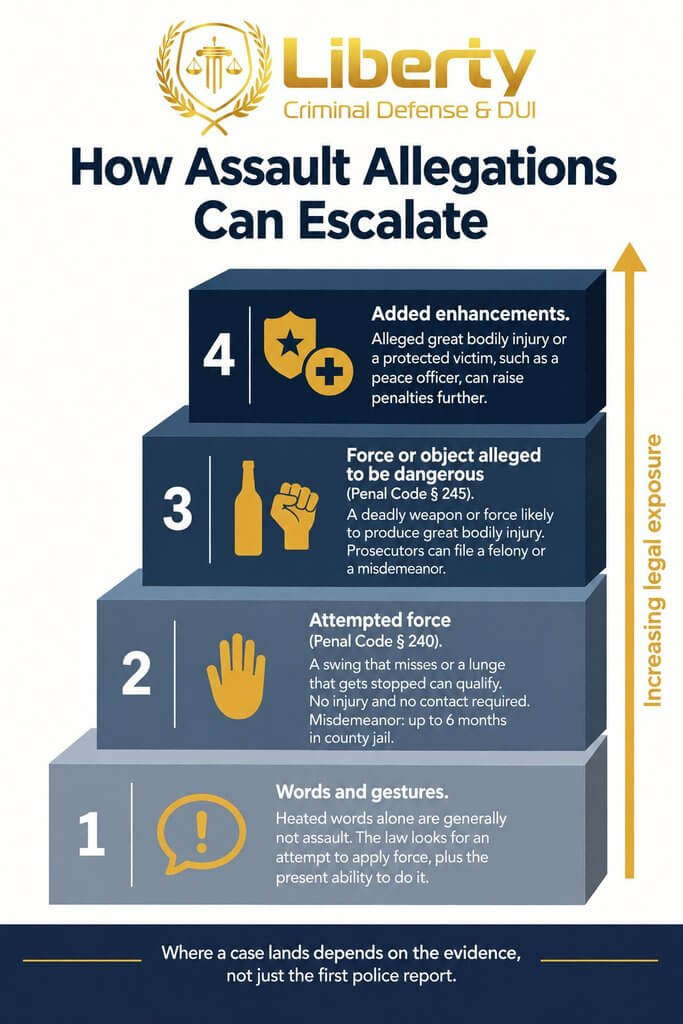
Penal Code § 240 defines assault as an unlawful attempt, along with the present ability, to commit a violent injury on someone. Read that sentence twice. It describes an attempt. Nobody has to get hurt. Nobody even has to get touched.
Picture two men arguing in a parking lot. One steps forward, cocks his fist, and swings. The other ducks, and the punch misses completely. No injury, no contact, and still a potential assault. Or picture someone who lunges to shove a coworker, but a bystander grabs their arm first. The force was possible and the attempt was real, even though it never finished.
Words alone do not meet the standard. Yelling “I’ll hurt you” from across a room, with no ability to act on it right then, generally falls short of assault. The “present ability” element matters.
The California Supreme Court explained the mental state in People v. Williams (2001) 26 Cal.4th 779. Prosecutors do not need to prove you wanted to injure anyone. They need to show you willfully acted and knew facts that would lead a reasonable person to realize your act would probably and directly result in force being applied to someone.
In practice, prosecutors generally must prove each of these beyond a reasonable doubt:
- You did an act that by its nature would probably and directly result in force against someone.
- You acted willfully.
- You knew the facts that made that result probable.
- You had the present ability to apply force.
- You did not act in lawful self-defense or defense of another.
Simple assault is a misdemeanor. Under Penal Code § 241(a), the maximum is up to six months in county jail, a fine of up to $1,000, or both.
What Is Aggravated Assault in California?
Penal Code § 245 covers the more serious versions. The two most common are assault with a deadly weapon and assault by force likely to produce great bodily injury. Both appear in § 245(a)(1), and the statute also addresses firearms, semiautomatic firearms, assault weapons, and machine guns in separate subsections.
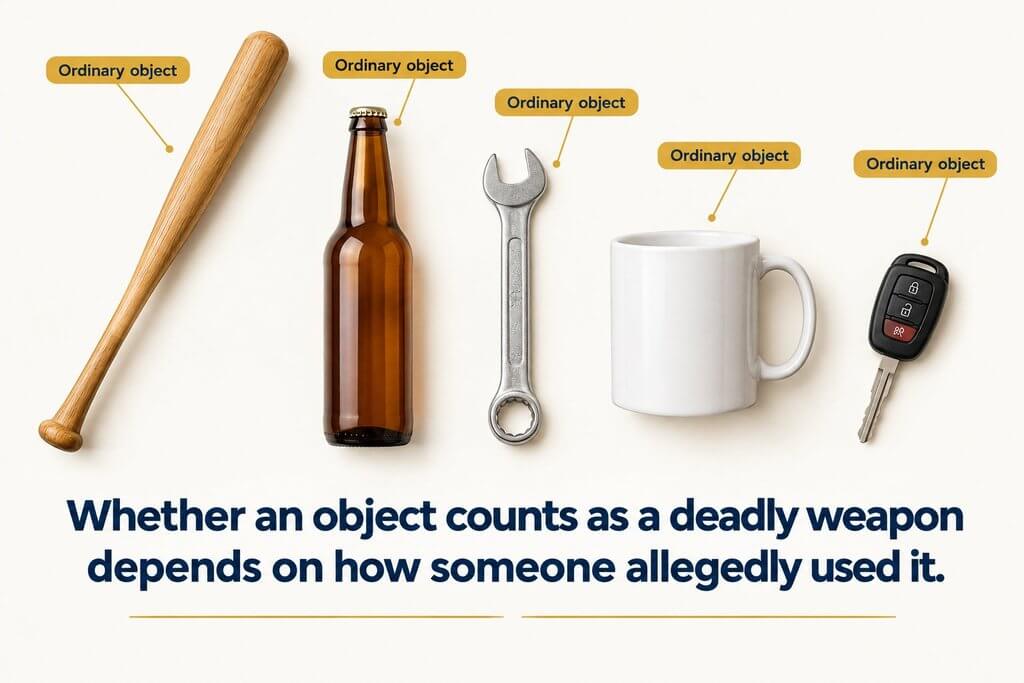
A “deadly weapon” covers far more than guns and knives. California courts treat an object as deadly when you use it in a way that could cause death or great bodily injury, and that is likely to do so. A baseball bat, a bottle, a tire iron, a heavy boot, or a car can qualify depending on how it was used. A kitchen knife sitting in a drawer is just a knife. The same knife pointed at someone during an argument tells a different story.
The second path does not require a weapon at all. If the prosecution claims your hands, fists, or feet delivered force likely to produce great bodily injury, § 245 can still apply. Here the force itself carries the charge.
Consider how one disagreement can split two ways. Two roommates fight over rent. One shoves the other, who stumbles into a wall. That sounds like a simple allegation. Change one detail: the roommate grabs a metal pan and swings it at the other’s head. Now a prosecutor can reasonably consider § 245. Same argument, very different exposure.
Penalties rise sharply. Assault with a deadly weapon or by force likely to produce great bodily injury is a “wobbler” under § 245(a)(1), so prosecutors can file it as a felony or a misdemeanor. A felony conviction carries two, three, or four years in state prison. A misdemeanor carries up to one year in county jail. Fines can reach $10,000. Firearm-based versions carry steeper ranges.
Simple Assault vs. Aggravated Assault: Key Differences
The cleanest way to frame simple assault vs aggravated assault is to ask three questions:
- How serious was the alleged force?
- Did a weapon play a role?
- Who was the alleged victim?
Simple Assault vs. Aggravated Assault in California
| Factor | Simple Assault | Aggravated Assault |
| Statute | Penal Code § 240 (penalty under § 241) | Penal Code § 245 |
| Usual charge level | Misdemeanor | Wobbler (felony or misdemeanor); some forms are felonies only |
| Role of injury | None required | None required, but alleged great bodily injury can drive the charge |
| Role of weapon | Not required | A deadly weapon can establish the charge |
| Role of force | Attempted force or violent injury | Force likely to produce great bodily injury |
| Possible penalties | Up to 6 months in county jail and up to $1,000 fine | Up to 4 years in prison for a felony, or up to 1 year in county jail for a misdemeanor, plus fines up to $10,000 |
| Defense considerations | Lack of present ability, no willful act, self-defense, misidentification | Whether the object was used as a deadly weapon, whether force was likely to cause great bodily injury, self-defense, credibility, misidentification |
A table can make the line look sharper than it is. In real cases, simple assault vs aggravated assault often depends on disputed facts. Witnesses remember events differently. Video may show only part of an encounter. Police reports sometimes lean toward the strongest charge. Prosecutors also have discretion, so the charge filed on day one may change after evidence comes in. Two cases with similar facts can end in very different places.
How Alleged Injuries Affect an Assault Case
Assault does not require injury, but injury shapes how seriously prosecutors view a case. It helps to separate three levels.
A minor injury might be redness, a small bruise, or a scrape. A significant injury might involve stitches, a fracture, or a concussion. Great bodily injury has a specific legal meaning. Under Penal Code § 12022.7, it means significant or substantial physical injury, not minor or moderate harm. That phrase also appears in § 245, where the question is whether the force was likely to produce that level of injury, even if it did not.
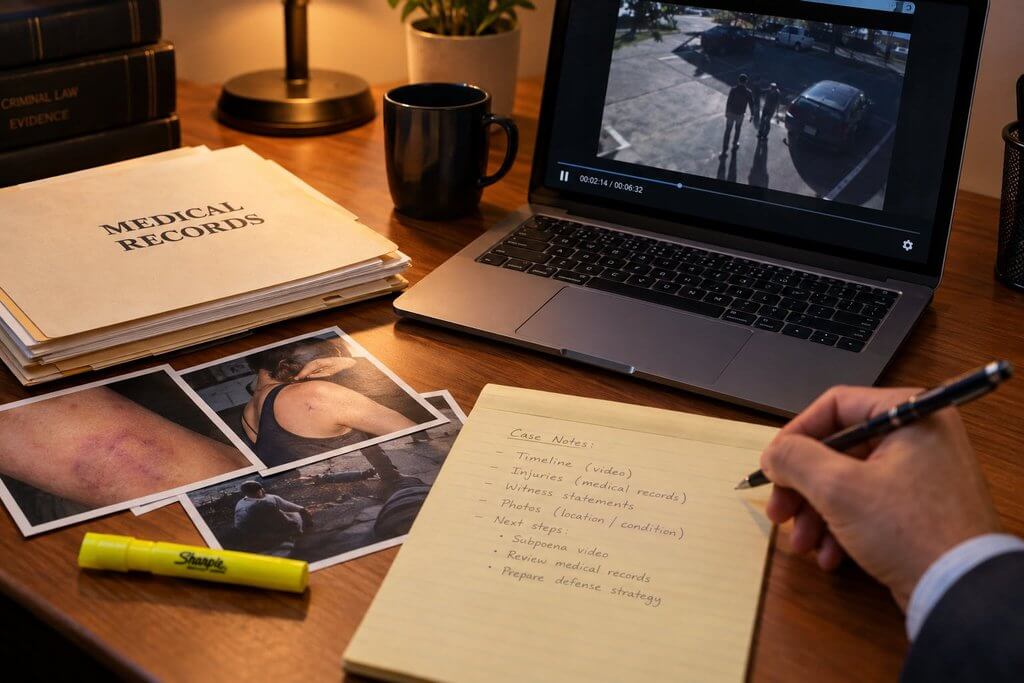
This is where evidence gets contested:
- Medical records show what treatment someone actually received and when.
- Photographs capture bruising that may fade or change within days.
- Witness accounts describe what happened and how the person looked afterward.
Timing matters too. A person who says they were seriously hurt but waited a week for care invites questions, and an injury photographed hours after an incident reads differently than one photographed weeks later.
Important: The absence of a visible injury does not automatically mean the case is weak, and a visible injury does not automatically prove the prosecution’s version of events.
Evan Vargas often reminds clients that an injury raises a second question beyond whether it exists: how it happened. A bruise could come from a fight, a fall, a prior incident, or an accident. The defense looks at the cause, not just the mark.
How Weapons and Alleged Intent Change the Case
Almost any object can become a deadly weapon in the eyes of a prosecutor, depending on how it was used. A glass in a bar is a drinking vessel until someone swings it at a face. A car is transportation until a driver allegedly aims it at a person. California courts look at the object’s nature, the way it was used, and the circumstances around it.
Intent deserves careful treatment. Prosecutors usually do not have to prove you wanted to seriously injure anyone. They focus on whether you acted willfully and whether the circumstances show you knew your conduct would likely result in force. A defendant who says “I never meant to hurt him” may still face a charge if the conduct itself looked dangerous.
Here are two contrasting scenarios:
- A spontaneous altercation: Two friends argue outside a restaurant. One throws a punch, and it glances off the other’s shoulder. There is no weapon, and there is no lasting injury. Prosecutors might file a misdemeanor, and the defense might dispute who started it or whether self-defense applies.
- An object used in a threatening way: During a dispute, someone grabs a wrench and swings it toward another person’s head. Even if it misses, the alleged use of the object raises the likelihood of a § 245 charge.
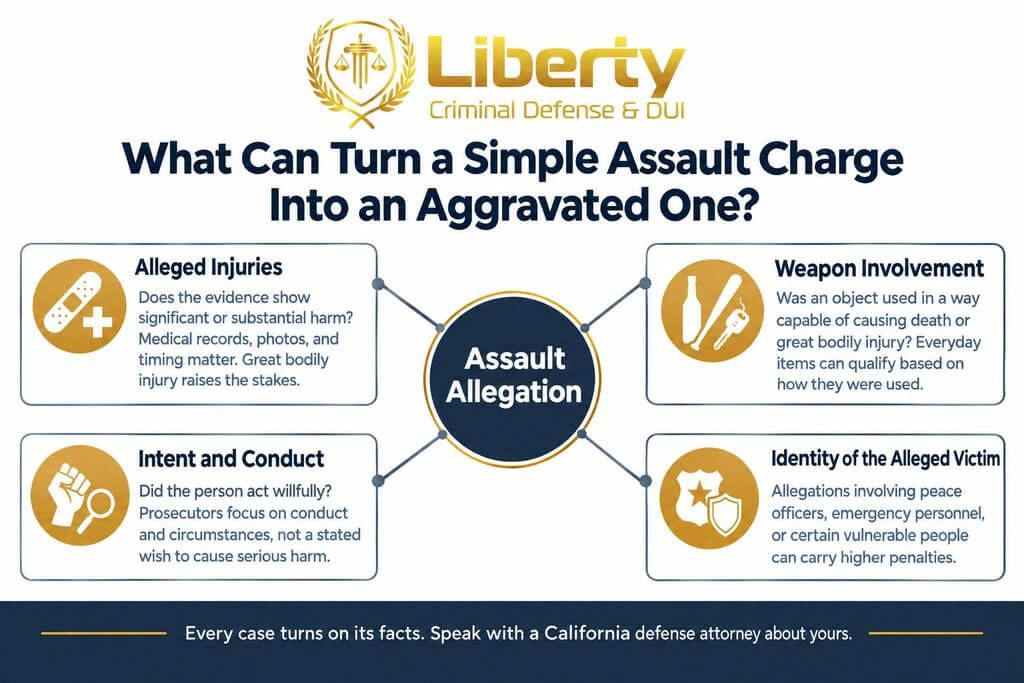
At Liberty Criminal Defence & DUI, we pay close attention to this distinction because the object and the alleged motion often decide the case. The infographic below shows the main factors that can raise a charge.
Factors That Can Elevate an Assault Charge
Why the Alleged Victim’s Identity Matters
California law treats some alleged victims differently. Penal Code § 241 sets higher penalties when the alleged victim is a peace officer, firefighter, emergency medical worker, or certain other protected individuals engaged in their duties. Section 245 also includes enhanced penalties for assaults on peace officers and firefighters. Certain vulnerable people, such as some school employees, transit workers, and others, can also fall into protected categories under related provisions.
A protected category raises the stakes. It does not decide the outcome. Prosecutors still have to prove every element of the offense beyond a reasonable doubt, and the defense has room to examine several questions:
- Was the person lawfully performing official duties at the time? If an officer used excessive force or acted outside the law, that can change the analysis.
- Did the defendant know, or reasonably should have known, the person’s status?
- Is the identification reliable, especially in a chaotic scene at night or in a crowd?
- Does the evidence support the alleged conduct, or does body camera footage tell a different story than the report?
Evan Vargas reviews these details early. A charge enhanced by the victim’s role can look intimidating on paper, yet the underlying evidence may be thinner than the label suggests.
Your Rights After an Assault Arrest in California
You have several protections, and they apply from the moment of arrest:
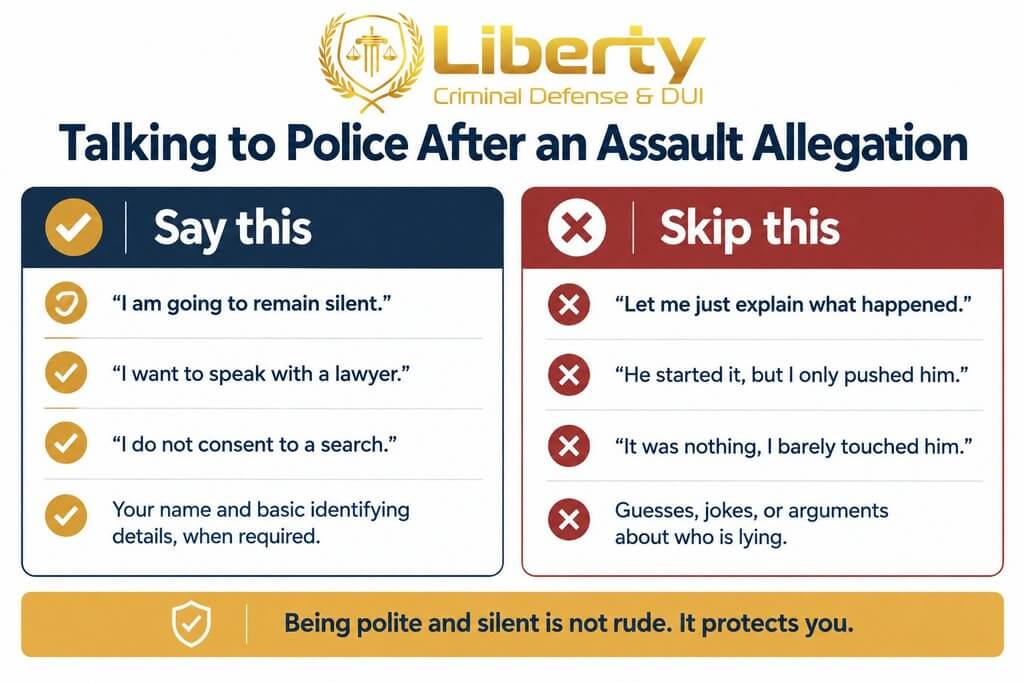
- You have the right to remain silent. You do not have to answer questions, explain your side, or discuss the incident.
- You have the right to an attorney, and you can ask for one at any point.
- You have the right against unreasonable searches and seizures, so police generally need a warrant, consent, or a recognized exception to search your phone, home, or car.
- You have the right to a defense, which includes the presumption of innocence and the prosecution’s burden of proof.
Speaking to police before you talk to a lawyer creates problems for a simple reason: almost everything you say becomes evidence. People often try to “clear things up” and end up admitting facts that fit an element of the charge. A casual comment such as “I only pushed him” can turn a disputed case into an easy one for the prosecution. At Liberty Criminal Defence & DUI, we hear this regret often. The instinct to explain is human, but it rarely helps.
Checklist: What To Do After an Assault Arrest
- Stay calm and keep your hands visible.
- Do not explain, argue, or tell your side of the story.
- Say clearly: “I want to remain silent and I want a lawyer.”
- Do not contact the alleged victim, directly or through friends.
- Save texts, voicemails, photos, and social media messages.
- Write down what happened while your memory is fresh, including names and times.
- Contact a criminal defense attorney promptly.
How To Protect Yourself Against Assault Charges
Prevention starts before anything happens. If a conflict heats up, the best move is usually to get out of it. Lower your voice, stay at a distance, and avoid pointing, grabbing, or blocking someone’s path. Even a small shove can turn a verbal argument into a legal problem. If you can leave safely, leave. Walking away from a confrontation is not a sign of weakness, and it can matter later if someone questions who escalated.

If something does happen, protect yourself afterward. Document the scene as soon as it is safe:
- Take photos of your own injuries, the location, and anything damaged.
- Write down who was there.
- Note whether cameras were nearby, since business footage is often overwritten within days.
- Keep every message related to the incident, even ones you think hurt you, and give them to your attorney instead of deleting them. Deleting evidence can create new legal trouble.
It’s also recommended that you stay off social media. Posts, comments, and even “private” messages can end up in a prosecutor’s file.
Common Mistakes That Can Hurt Your Defense
- Contacting the alleged victim. Even a friendly apology can look like pressure, and a protective order may bar contact altogether.
- Posting about the incident. Online comments are easy for prosecutors to find and quote.
- Minimizing the facts to police. “It was nothing, I barely touched him” is still an admission.
- Missing court dates. A missed appearance can lead to a bench warrant and extra charges.
- Waiting too long to hire counsel. Evidence disappears quickly, and early choices are hard to undo.
Common mistake to avoid: Trying to “fix it” by talking with the other person or the police before you speak to a lawyer. Good intentions can still create evidence against you. Already made one of these mistakes? It happens, and it is often fixable. Talk to a defense lawyer before you take any further steps.
Why You Should Speak With a California Defense Attorney Quickly
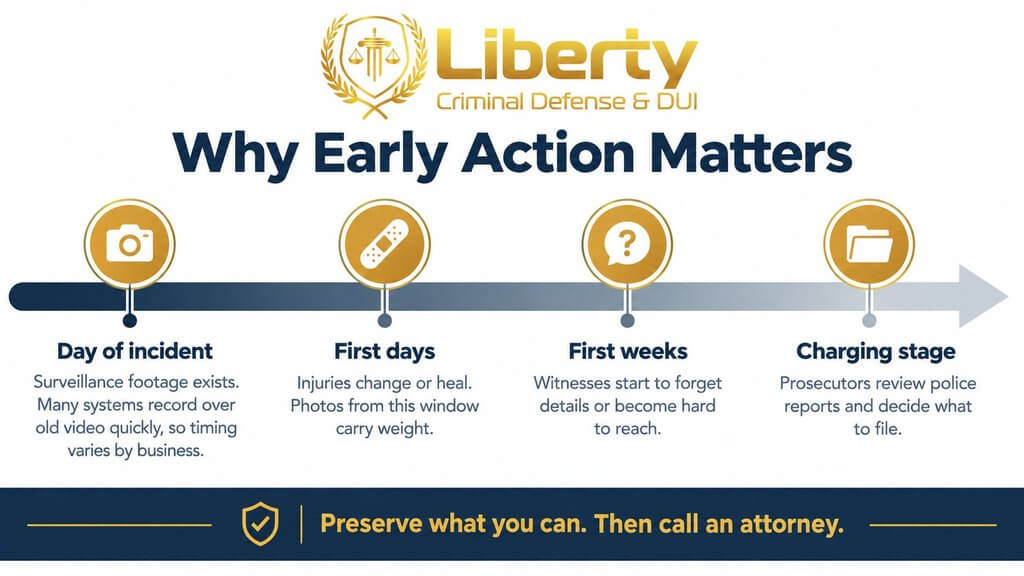
Time works against people accused of assault. Surveillance footage gets recorded over. Witnesses forget details or become hard to reach. Police reports harden into the official version of events. Prosecutors may also decide on charges soon after an arrest, which means early advocacy can influence whether a case is filed as a misdemeanor or a felony, or filed at all.
This is where understanding simple assault vs aggravated assault becomes practical rather than academic. A criminal defense lawyer who engages early can request and preserve video, interview witnesses, and present facts to the prosecution before positions lock in.
Here is how Evan Vargas and Liberty Criminal Defence & DUI approach assault cases. We review the police reports, body camera footage, medical records, and any witness statements. We look for weaknesses, such as unreliable identification, inconsistent accounts, missing evidence of a weapon, or injuries that do not match the allegations. We protect your rights throughout, including at interviews, hearings, and negotiations. Then we work toward the best outcome available, whether that means a dismissal, a reduced charge, or a trial.

The firm also handles DUI charges and a broad range of other criminal defense matters, but assault allegations deserve their own careful attention. Every case depends on its facts, and nothing in this article is legal advice. If you are facing an assault allegation, talk with a qualified California criminal defense attorney. You are welcome to contact Liberty Criminal Defence & DUI for a free consultation. There is no pressure, just a chance to understand where you stand.
Frequently Asked Questions
Can simple assault become aggravated assault?
Yes. In a simple assault vs aggravated assault decision, prosecutors can upgrade the charge when they believe a deadly weapon was involved or the force could cause great bodily injury. The arrest report does not fix the final charge.
Do you have to touch someone to commit assault?
No. Assault requires an attempt to commit a violent injury and the present ability to do it, not contact. Once contact happens, the allegation usually becomes battery. A swing that misses can still support an assault charge.
Is aggravated assault always a felony?
No. Assault with a deadly weapon and assault by force likely to produce great bodily injury are wobblers, meaning prosecutors can charge them as felonies or misdemeanors. Firearm assaults under section 245 are felonies.
Can self-defense apply to an assault charge?
Yes. Self-defense can defeat an assault charge if you reasonably believed you faced imminent harm and used no more force than necessary. Prosecutors must disprove it beyond a reasonable doubt once the defense raises credible evidence.
What should you do if you are falsely accused?
Stay calm, avoid explaining your side to police, and do not contact the accuser. Save texts, photos, and names of witnesses, then call a defense attorney. Early, organized evidence often matters more than a quick denial.
When should you contact a criminal defense attorney?
Contact an attorney as soon as you learn of an investigation, arrest, or protective order, ideally before any police interview. Early involvement helps preserve video, locate witnesses, and shape how prosecutors view the case.
Simple Assault vs. Aggravated Assault: The Bottom Line
The practical difference comes down to attempted force versus a weapon or force likely to cause great bodily injury. Simple assault is a misdemeanor under § 240. Aggravated assault falls under § 245 and can bring felony exposure and prison time. The simple assault vs aggravated assault line often depends on contested details, including the object used, the alleged injuries, and who the alleged victim was.
If you face an allegation, you do not have to sort it out alone. Liberty Criminal Defence & DUI and attorney Evan Vargas can review your situation, explain your options, and help you decide on next steps. A calm conversation now can make a real difference later.