If you were just arrested, or someone you love was, you have probably already typed “DUI vs DWI” into a search bar, trying to figure out how much trouble you are actually in. That instinct makes sense. The two terms get thrown around like they mean different things, and half the articles online muddy the water instead of clearing it up.
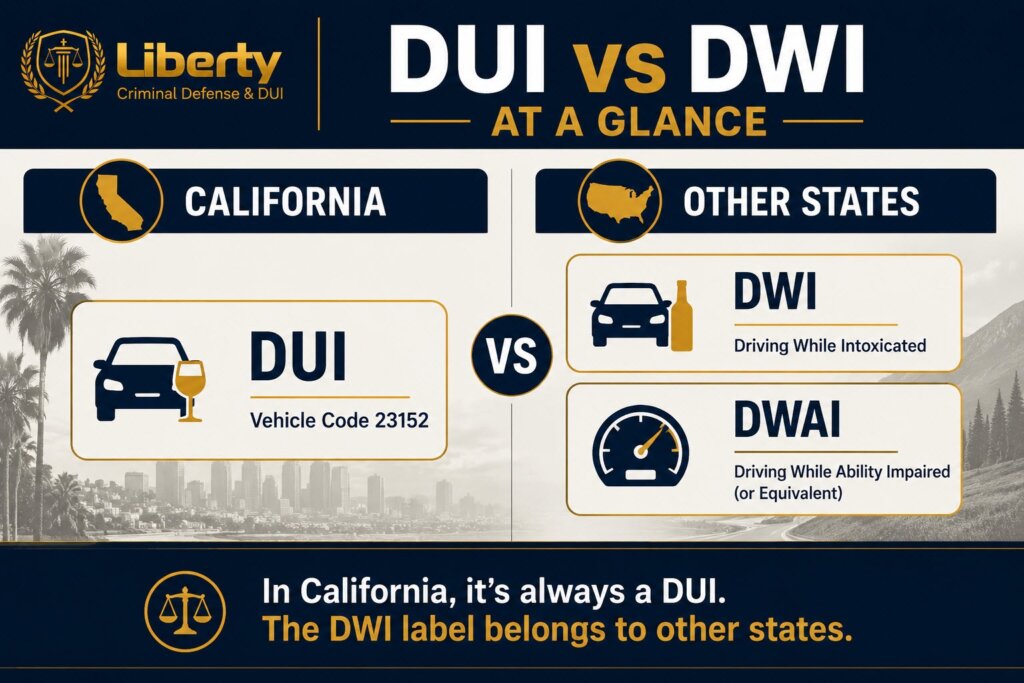
Here is the short version, and then we will walk you through why it matters. In California, there is no legal distinction between a DUI and a DWI. They describe the same offense. The confusion comes from the fact that other states use different labels, television and movies borrow terms from wherever, and search engines have trained people to look up both phrases separately. Once you understand that California only prosecutes one version of this crime, the rest of the picture gets a lot easier to follow.
As a California defense attorney who has spent over two decades in the Riverside Hall of Justice and other Southern California courts, Evan Vargas wants to clear this up for you. Understanding these terms is the first step in taking control of your defense. While the language can be confusing, the legal reality in California is quite specific. The label on the charge matters far less than what happens in the seventy two hours after an arrest. That is where cases get won, lost, or quietly given away by people who did not know their rights. Let’s get into the details.
What DUI Actually Means
DUI stands for driving under the influence. In California, this charge lives in Vehicle Code Section 23152, and it actually covers a few different ways prosecutors can go after you.
Under 23152(a), you can be charged simply for driving while impaired by alcohol, regardless of your exact blood alcohol concentration. The prosecution has to show your physical or mental ability to drive safely was affected. This is a subjective standard built on the officer’s observations: how you were driving, whether you smelled like alcohol, how you performed on field sobriety tests, and how you spoke and moved.
Under 23152(b), the law takes a completely different approach. It does not ask whether you were actually impaired. It asks whether your BAC was 0.08 percent or higher at the time you were driving. This is called a per se violation, meaning the number itself is the crime. You could be walking a straight line, speaking clearly, and feel completely fine, and still be convicted if a chemical test puts you at or above that threshold.
Here is something most people do not realize until it happens to them: California prosecutors almost always file both charges from the same arrest. You are not going to end up with two convictions on your record for one incident, since the law merges them into a single DUI conviction if you are found guilty of both. But during the case itself, the prosecution effectively gets two separate paths to a conviction, which is exactly why these cases are harder to beat than people assume going in.
There are also related versions of the charge that come up more often than people expect. Driving while addicted to drugs falls under 23152(c). Driving under the influence of any drug, including cannabis or prescription medication, falls under 23152(f). Combining alcohol and drugs falls under 23152(g). None of these require you to have been drinking at all, which surprises a lot of clients who assumed a DUI only applies to alcohol.
What DWI Means, and Where the Term Comes From
DWI stands for driving while intoxicated, or in some states, driving while impaired. It is the label used in states like New York and Texas, and it sometimes distinguishes between a lesser and greater offense within the same state. New York, for example, treats a DWI as more serious than a related charge called DWAI, which stands for driving while ability impaired.
California never adopted this terminology. There is no separate DWI statute here, and no prosecutor in a California courtroom is going to charge you with a DWI. If you see that phrase used in connection with a California arrest, it is almost always a search engine habit rather than a legal distinction. People search for both terms because they are unsure which one applies to their state, and content written for a national audience tends to use both interchangeably to capture that traffic.
This matters practically in one specific way. If you are reading advice online about DWI penalties, refusal consequences, or court procedures, you may be reading rules that apply to a different state entirely. A DWI refusal in New York triggers different administrative consequences than a chemical test refusal in California. Mixing up the two can lead you to prepare for the wrong process or misjudge how serious your situation actually is.
DUI vs. DWI: Quick Terminology Comparison
| DUI (California term) | DWI (used in other states) | |
| Meaning | Driving under the influence of alcohol or drugs | Driving while intoxicated or impaired |
| Used in California courts? | Yes, the only term used | No, not a legal term here |
| Governing law | Vehicle Code 23152 | Varies by state (e.g., NY Vehicle & Traffic Law 1192) |
| Scope | Includes alcohol, illegal drugs, marijuana, and prescriptions | Often refers specifically to alcohol in other states |
| Legal Weight | A criminal offense that can be a misdemeanor or felony | Typically the same weight as a DUI in states that use it |
| BAC threshold | 0.08% for drivers 21+, 0.01% under 21, 0.04% commercial | Varies, generally similar limits |
| Common source of confusion | National search habits, media use of both terms | Some states use DWI for a more serious tier than a lesser charge |
How California Treats These Cases Differently
Because California only recognizes the DUI framework, every arrest in this state, whether it involves alcohol, cannabis, prescription medication, or a combination, gets funneled into the same statute. That has some real consequences for how your case unfolds.
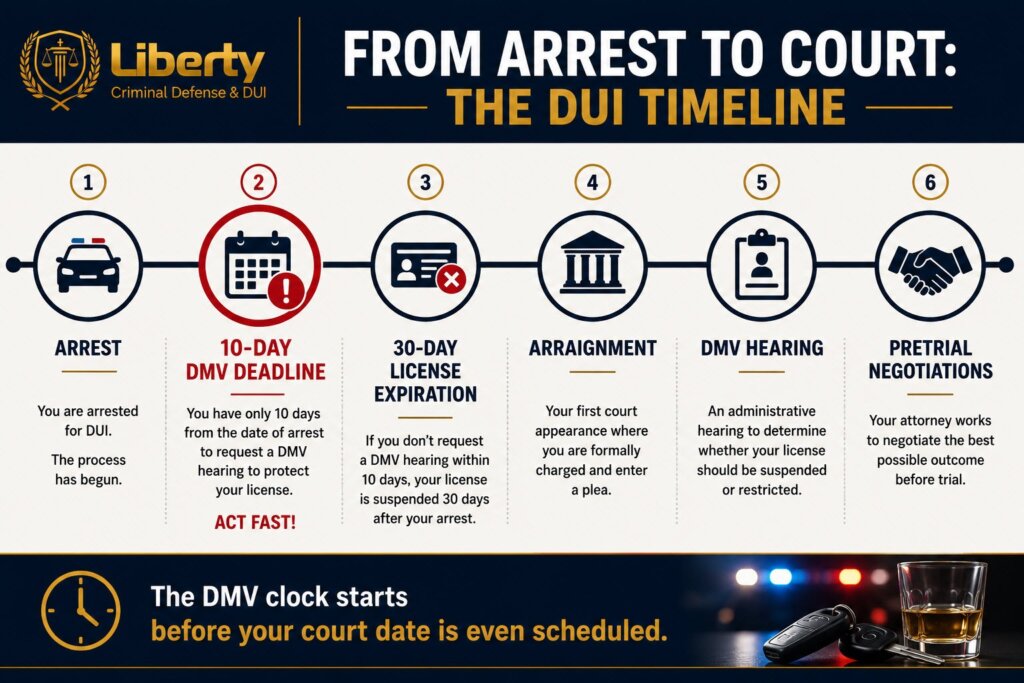
First, California allows two parallel proceedings to happen at once. There is the criminal case, heard in court, and there is a completely separate administrative action run by the DMV, known as an Administrative Per Se hearing. Many states handle license suspension purely through the criminal court. California splits it off, and the DMV clock starts running the moment you are arrested, regardless of whether you are ever convicted.
Second, California’s per se limit sits at the same 0.08 percent used in most of the country, but the rules shift for certain drivers. If you are under 21, California applies a zero tolerance standard of 0.01 percent under its Zero Tolerance Law. Commercial drivers face a 0.04 percent threshold. If you are on DUI probation from an earlier offense, you may be held to a 0.01 percent standard even as an adult, since many probation terms include a Watson advisement and a requirement to maintain a completely sober BAC while driving.
Third, California treats most DUIs as misdemeanors, but the offense escalates to a felony under specific conditions: a fourth DUI or wet reckless conviction within ten years, a prior felony DUI conviction, or a case involving injury to another person. Felony DUI convictions carry the possibility of state prison time rather than county jail, and they follow you in ways a misdemeanor generally does not, including firearm rights and certain professional licenses.
Why the Science Behind BAC Numbers Matters More Than People Think
Because 23152(b) is a per se law, your case can hinge entirely on a number produced by a machine or a lab. That sounds simple until you understand how much can go wrong between the moment you were pulled over and the moment that number gets typed into a police report.
Breath testing devices have to be calibrated and maintained according to Title 17 of the California Code of Regulations. If an agency skipped a calibration check or stored a blood sample incorrectly, the result can be challenged. There is also a phenomenon defense attorneys call rising blood alcohol. Your body absorbs alcohol over time, so it is entirely possible for your BAC to have been under 0.08 percent while you were actually driving, only to rise above that line by the time you took a test back at the station, sometimes forty five minutes or more later. California law tries to account for this with a rebuttable presumption that your BAC at the time of testing reflects your BAC at the time of driving if the test happened within three hours of the stop, but that presumption can be challenged with the right toxicology evidence.
None of this is a magic trick that makes charges disappear. But it is exactly the kind of detail that separates a case handled by someone like Evan Vargas who understands the science from one that gets rushed through as a routine plea.
What Happens After a DUI Arrest in California
Every DUI arrest in California kicks off a sequence of deadlines that most people never see coming. Understanding the order of events helps you make better decisions in the first few days, when the instinct to just wait and see is exactly the wrong instinct.
At the scene, the officer will typically conduct field sobriety tests and a preliminary alcohol screening (PAS) breath test, which is voluntary for drivers over 21 who are not on probation. If you are arrested, you are then required to submit to a chemical breath or blood test under California’s implied consent law. Refusing that test carries its own separate penalties, including a longer license suspension, regardless of how your criminal case turns out.
Your license gets physically confiscated at the time of arrest. In its place, the officer hands you a pink form, DS-367, which functions as a temporary license for 30 days and doubles as your official notice that the DMV intends to suspend your driving privileges.
What Happens After a DUI Arrest: Step-by-Step
| Stage | What Happens | Why It Matters |
| Arrest | Officer confiscates license, issues pink DS-367 temporary license | This document contains your DMV deadline |
| Within 10 days | You or your attorney must request a DMV Administrative Per Se hearing | Missing this window waives your right to fight the license suspension entirely |
| Within 30 days | Temporary license expires | If no hearing was requested, automatic suspension begins |
| Arraignment | You are formally charged in criminal court | This starts the criminal case timeline, separate from the DMV |
| DMV hearing (if requested) | An administrative law hearing, not a courtroom | Decided by preponderance of evidence, a lower bar than criminal court |
| Pretrial phase | Discovery, negotiation, and motions to suppress evidence | Most cases are resolved here, not at trial |
The 10-Day Rule Deserves Its Own Warning
If there is one fact from this article you take away, make it this one. You have exactly 10 calendar days from your arrest to contact the DMV and request an Administrative Per Se hearing. Weekends and holidays count toward that window. According to California Vehicle Code Section 13558, failing to request a hearing within that period is treated as a waiver of your right to contest the suspension.
We have had clients come in on day 12 or 13 with a strong case, and there was nothing we could do about the license suspension by that point, even though we later got the criminal charge reduced. The DMV process and the criminal case run on separate tracks, and winning one does not automatically fix the other. If your license is important to your job, your family responsibilities, or simply getting through your day, this is not a deadline to sleep on.
What You Should Do Immediately After an Arrest
The hours right after a DUI arrest feel chaotic, and it is easy to either panic or convince yourself the whole thing will blow over. Neither reaction serves you. Here is what actually helps.
- Write down everything you remember while it is fresh, including where you were stopped, what the officer said, what tests you were asked to perform, and the approximate times involved.
- Do not discuss the details of your arrest with friends, family, or on social media. Anything you say can end up in front of a prosecutor, and casual comments get taken out of context constantly.
- Locate your pink DS-367 form and note the date on it. That date controls your 10-day DMV deadline.
- Contact a DUI attorney before your arraignment, ideally within the first few days, so the DMV hearing request can be filed on time and evidence can be preserved before it disappears.
- Avoid driving on a suspended or restricted license before your case is resolved. A second offense while your first is still pending compounds your exposure dramatically.
One point clients often miss: body camera footage, dispatch recordings, and breathalyzer maintenance logs are not necessarily kept forever. Some agencies purge footage on a rolling schedule. The sooner your attorney sends a preservation request, the better your chances of getting a complete picture of what actually happened that night.
What Happens If You Are Convicted
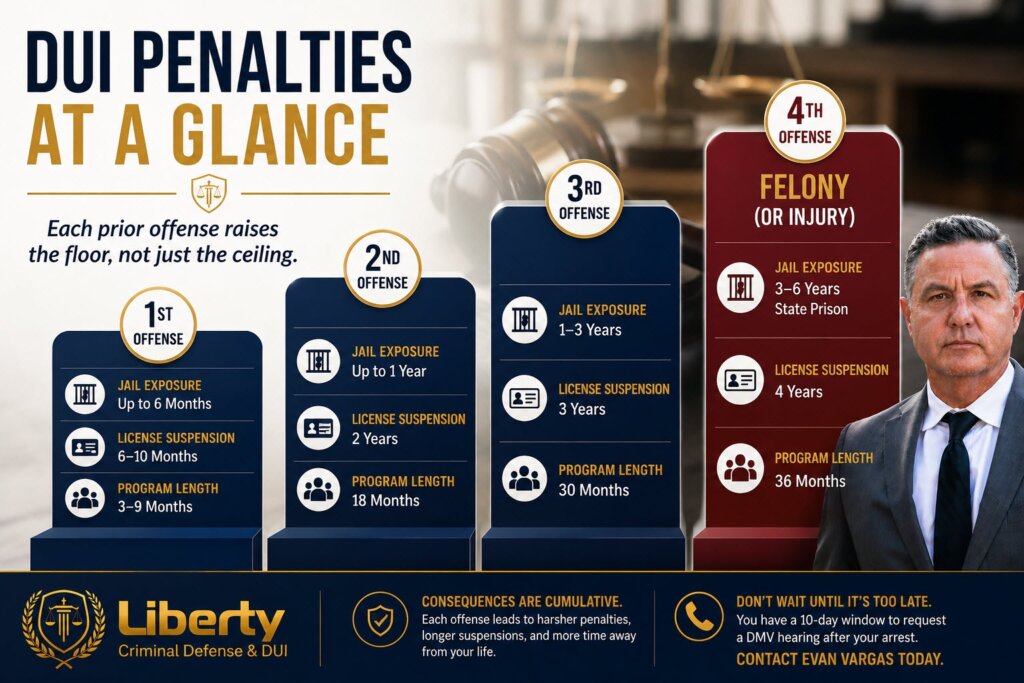
Penalties in California scale with your prior record, whether anyone was injured, and your BAC level at the time of arrest. A first offense misdemeanor conviction typically involves informal probation, fines and court fees that often run into the thousands of dollars once penalty assessments are added, a DUI education program lasting three to nine months, and a license suspension that can sometimes be served as a restricted license if you install an ignition interlock device.
Second and third offenses within a ten year window bring longer mandatory minimum jail terms, longer license suspensions, and longer education programs. A fourth offense within ten years, or any DUI causing injury, can be charged as a felony, opening the door to state prison and a permanent felony record.
General Penalty Ranges for a California DUI
| Offense | Typical Jail/Probation | License Impact | DUI Program Length |
| 1st offense (misdemeanor) | Summary probation, up to 6 months jail (rarely served in full) | 6-month suspension, restricted license often available | 3 to 9 months |
| 2nd offense within 10 years | Minimum jail time required, longer probation | 2-year suspension | 18 months |
| 3rd offense within 10 years | Longer mandatory jail term | 3-year suspension, may be declared a habitual offender | 30 months |
| 4th offense within 10 years | Can be charged as a felony, possible state prison | 4-year suspension or more | 30 months |
| DUI causing injury | Can be a felony regardless of prior record | Suspension up to 3 years or more | Varies by court |
These figures are general ranges. Actual sentencing depends heavily on the county, the judge, your BAC, whether there was an accident, and the strength of the evidence against you. Los Angeles County courts, in particular, vary quite a bit by courthouse in how they approach plea offers, which is one more reason local experience matters more than people expect.
Beyond the court-imposed penalties, a DUI conviction carries consequences that do not show up in a sentencing chart. Auto insurance premiums often double or triple for three to five years. Many professional licenses require disclosure of a DUI conviction. Commercial driver’s license holders can lose their CDL entirely, even if the offense happened in a personal vehicle. And any conviction, wet reckless included, can complicate travel to countries with strict entry rules for anyone with a criminal record, Canada being the most commonly cited example.
Why Hiring a DUI Lawyer Actually Changes the Outcome
We understand the instinct to assume a DUI case is straightforward: you either blew over the limit or you did not, and the rest is paperwork. That is rarely how it actually plays out. Every step of a DUI case, from the initial stop to the chemical test, has to follow specific legal and procedural rules, and prosecutors do not go looking for the weak points in their own evidence. That is the defense attorney’s job.
A few of the areas where experienced counsel tends to make the biggest difference:
- Challenging the basis for the traffic stop itself. If the officer lacked reasonable suspicion or probable cause, evidence gathered afterward, including chemical test results, can potentially be suppressed.
- Scrutinizing breathalyzer calibration records and blood sample chain of custody under Title 17 requirements.
- Handling the DMV hearing directly, since this is a specialized administrative process most people have never encountered and the standard of proof works differently than in criminal court.
- Negotiating reduced charges such as a wet reckless (Vehicle Code 23103.5) or dry reckless, which can meaningfully reduce penalties, insurance impact, and long-term record consequences.
- Identifying whether rising blood alcohol, medical conditions, or testing equipment issues affected the accuracy of your BAC result.
None of this is about making a DUI disappear through some clever trick. It is about making sure the government actually proves what the law requires it to prove, using evidence that was collected properly. According to Evan Vargas, the clients who come in early, before their arraignment and well before the 10-day DMV deadline, consistently end up with more options than the ones who wait to see what happens.
Why Evan Vargas Is the Attorney to Call in Southern California
Everything in this article explains why a DUI case is rarely as simple as the number on a breathalyzer. Knowing that is one thing. Having someone in your corner who has spent two decades inside California courtrooms picking apart that exact kind of evidence is another.
Evan Vargas is a Southern California native who earned his Juris Doctorate from the University of West Los Angeles in 2003 and was admitted to the California Bar in 2004. Since then, he has built his practice around defending people facing DUI and criminal charges throughout the Inland Empire and greater Southern California, representing clients across Riverside County, San Bernardino County, Los Angeles County, and Orange County courthouses.
A few things set his approach apart from a general practice attorney who happens to take DUI cases on the side.
- Two decades of DUI-specific experience. Evan has spent his entire career learning how local prosecutors build these cases and, more importantly, where they tend to be weakest, from the initial stop through breath and blood test procedures.
- Direct familiarity with the local courthouses. Knowing how a case is likely to be handled in Rancho Cucamonga, San Bernardino, Riverside, or Orange County is not something you get from a law degree. It comes from standing in those courtrooms for years, in front of the same judges and against the same deputy district attorneys.
- A track record of negotiated reductions and dismissals. Evan’s approach has consistently produced favorable plea agreements and case dismissals for clients facing everything from first-time misdemeanor DUIs to felony DUI and injury cases.
Clients who have worked with him describe someone who explains the process in plain language, stays reachable by phone, text, and email throughout the case, and fights for reduced charges rather than pushing clients toward the fastest plea deal available. That combination, deep DUI-specific knowledge paired with real accessibility, is exactly what you want when your license, your record, and potentially your freedom are on the line.
Frequently Asked Questions
Is DUI or DWI worse in California?
Neither is worse in California because the state only uses one term: DUI. California Vehicle Code 23152 governs all impaired driving charges, so DWI carries no separate or lesser legal meaning here.
What is the legal BAC limit in California?
The legal limit is 0.08% for drivers 21 and older, 0.04% for commercial drivers, and 0.01% for drivers under 21 or on DUI probation, under California Vehicle Code 23152(b).
How many days do I have to request a DMV hearing after a DUI arrest?
You have 10 calendar days from your arrest to request a DMV Administrative Per Se hearing. Missing this deadline waives your right to contest your license suspension, regardless of your criminal case outcome.
Can I be charged with DUI even if I passed the field sobriety test?
Yes. California’s per se law (23152(b)) allows a DUI charge based solely on a BAC of 0.08% or higher, even if you showed no visible signs of impairment.
What happens if I refuse a breath or blood test in California?
Refusing a chemical test triggers an automatic license suspension under California’s implied consent law, separate from and in addition to any penalties from the underlying DUI charge itself.
Will a first-time DUI put me in jail in California?
Most first-time misdemeanor DUI convictions result in summary probation, fines, and a DUI education program rather than actual jail time, though a judge can still impose up to 6 months.
How soon should I contact a DUI lawyer after an arrest?
Contact a DUI lawyer immediately, ideally within a day or two. Acting early protects your 10-day DMV hearing deadline and preserves evidence like dash-cam and breathalyzer records before it disappears.
Facing a DUI or DWI Charge? Talk to Evan Vargas Before Your Next Move
Whether you call it a DUI or a DWI, the reality is that your freedom and your future are at stake. The legal system in Southern California is designed to process you quickly, not necessarily fairly. To the prosecutors, you are often just another case number.
At Liberty Criminal Defense & DUI, we believe you are a person with a story, and you have a right to be heard. We utilize our deep knowledge of local court procedures and judges to give you the bold, strategic defense you deserve.
Do not let one mistake define the rest of your life. Contact Senior Partner Evan Vargas today for a free consultation by filling out our simple contact form or calling us at 909-787-2073. We have offices in Corona, Los Angeles, and Irvine to serve you. Let’s start building your defense now.
Legal Disclaimer: This article is provided for general informational purposes only and does not constitute legal advice. DUI and DWI laws vary by state, and the details here focus specifically on California law, which may not reflect the law in your jurisdiction or the specific facts of your case. If you have been arrested, speak with a licensed California DUI attorney about your situation before making decisions that affect your license or your case.