
Quick answer: If you refuse a DUI chemical test after a lawful arrest in California, the DMV will suspend your driver’s license for at least one year, and the refusal can be used as evidence in your criminal case. You have 10 days to request a DMV hearing to challenge the suspension.
Most people assume they have the right to say no to a breath or blood test. It feels like a basic principle since you can’t be forced to hand over evidence against yourself. California operates under what’s called an “implied consent” law, and it changes the calculus the moment an officer decides your arrest was lawful. What looks like a straightforward decision on the side of the road can turn into two separate legal fights, one with the DMV over your license and one in criminal court over the DUI charge itself.
What also catches people off guard is the fact that refusal doesn’t require you to say “I refuse.” Hesitating, asking too many questions, not providing enough breath for a valid sample, or misunderstanding what the officer asked can all be reported as a refusal. And once that report is written, you’re now dealing with consequences on two fronts at the same time, often on a tight clock you didn’t know existed.
At Liberty Criminal Defence & DUI, Evan Vargas has spent years untangling refusal allegations that were more about confusion, medical issues, or unclear advice than an actual “no.” If you’re facing one of these allegations, understanding how the process works is the first step toward protecting your license and your case.
What Is a DUI Chemical Test Refusal in California?
California’s implied consent law, found in Vehicle Code § 23612, says that by driving on California roads, you’ve already agreed to submit to chemical testing if you’re lawfully arrested for DUI. You didn’t sign anything. You didn’t verbally agree to it at any point. The law treats the act of driving itself as consent, and that consent only becomes relevant once an officer has grounds to arrest you.
This is a narrower rule than people assume. It doesn’t apply during a routine traffic stop, and it doesn’t apply before an arrest. Before you’re arrested, an officer might ask you to take a preliminary alcohol screening test, commonly called a PAS test, using a handheld breath device at the roadside. For most adult drivers, that test is voluntary. You can generally decline it without triggering the refusal penalties this article is about.
Once you’re arrested, the situation changes. Now you’re required to complete an evidentiary chemical test, meaning a breath or blood test administered at the station or another facility, to measure your blood alcohol content. This is the test tied to implied consent. Urine testing comes up occasionally, but usually only when breath and blood testing aren’t practical or when the case involves suspected drug use rather than alcohol.
The part that surprises people is that a “refusal” doesn’t have to be a flat verbal denial. It can include not producing enough air for a valid breath sample, going quiet and not responding to the officer’s request, or appearing to stall long enough that the officer documents it as a refusal. The circumstances around that moment, including what the officer actually said and whether you understood it, matter a great deal when this allegation gets challenged later.
Can You Legally Refuse a DUI Chemical Test in California?
Once you’ve been lawfully arrested for DUI, you don’t have an unrestricted legal right to refuse the evidentiary chemical test without consequences. That’s the short answer. The longer answer involves several distinct scenarios that often get lumped together under the word “refusal,” even though they’re legally different.
There’s a real difference between actively declining to cooperate, saying an outright “no,” failing to produce an adequate sample despite trying, and being physically unable to complete the test because of a medical condition, injury, or something else outside your control. There’s also a separate category worth mentioning. There are cases where the driver disputes that a refusal happened at all, arguing the officer’s account doesn’t match what actually occurred.
We’re not going to tell you that refusing testing is a smart strategy, because it usually isn’t, and we’re also not going to pretend every refusal allegation is accurate. What we can tell you is that the decisions made in the minutes after a DUI stop can shape the rest of your case, and what feels like a small moment of confusion at 2 a.m. can turn into a documented “refusal” that follows you into both the DMV process and criminal court. If you’re in that situation, the specifics of what happened matter more than any generic advice.
California’s Implied Consent Law Explained
Vehicle Code § 23612 is the statute behind all of this. Stripped of legal language, it says that driving in California means you’ve agreed in advance to chemical testing if you’re lawfully arrested for DUI. Here’s a breakdown of how it actually works.
| Issue | What It Means |
| Implied consent | By driving in California, you agree to submit to chemical testing if lawfully arrested for DUI. |
| When it applies | After a lawful DUI arrest, not during a routine traffic stop or before arrest. |
| Chemical testing | Breath or blood tests are required; urine tests are used only in limited circumstances. |
| Refusal | Failing or refusing to complete the test after being properly advised can trigger penalties. |
| Potential consequences | DMV license suspension, enhanced criminal penalties, and refusal evidence in court. |
The advisement point is worth pausing on. Officers are required to inform you of the consequences of refusing before those consequences can be enforced. If that advisement was garbled, incomplete, or never given in a way you could actually understand, it becomes a real issue in both the DMV hearing and the criminal case.
Breath Test vs. Blood Test vs. Urine Test
Not all chemical tests work the same way, and the differences matter more than most people realize.
| Test | When It May Be Used | Key Considerations |
| Breath | Most common post-arrest test; portable and non-invasive. | Can be affected by medical conditions, mouth alcohol, or improper administration. |
| Blood | Required if drugs are suspected or if breath is unavailable. | More accurate, but requires trained personnel and may involve medical privacy issues. |
| Urine | Only if both breath and blood are unavailable, or for drug-related DUIs. | Less accurate for alcohol; used primarily for drug detection. |
There isn’t a test that’s always the better choice. Breath testing is faster and less invasive, but it can be thrown off by acid reflux, certain medical conditions, or an officer who didn’t follow the required observation period. Blood testing tends to be more precise, but it depends on proper collection, handling, and storage, and any break in that chain can raise questions. Which test applies in your case, and whether it was administered correctly, depends entirely on the facts.
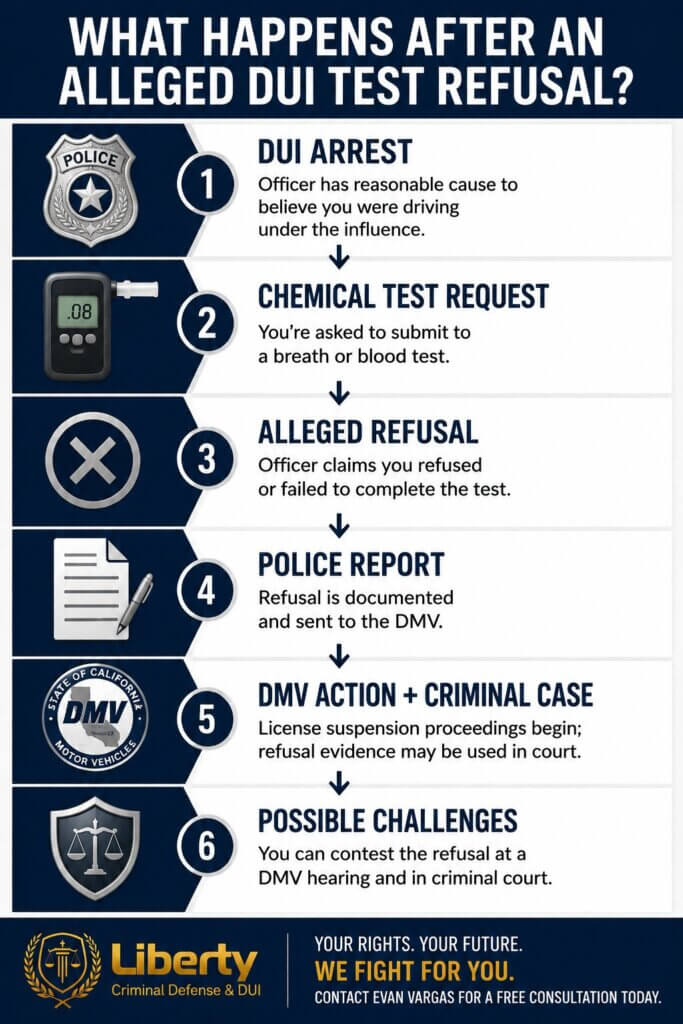
What Happens If Police Say You Refused?
Once an officer decides you’ve refused testing, a fairly predictable sequence starts.
First, the officer documents the alleged refusal in the arrest report, usually noting what was said, what wasn’t said, and the sequence of events. That report becomes part of the evidence against you, meaning the refusal itself can later be presented in criminal court as something the prosecution argues shows consciousness of guilt.
At the same time, the officer forwards paperwork to the DMV, which sets an administrative license suspension process in motion, separate from anything happening in the criminal case. You typically get a temporary license good for a limited period, and if you don’t act within that window, the suspension becomes permanent on its own timeline regardless of what happens in court.
You do have the opportunity to push back on all of this. You can request a DMV hearing to contest the suspension, and your attorney can challenge the refusal allegation as part of your overall criminal defense. But both of these are separate tracks that require separate action, and missing a deadline on one doesn’t pause the other.
Criminal DUI Case vs. DMV License Consequences
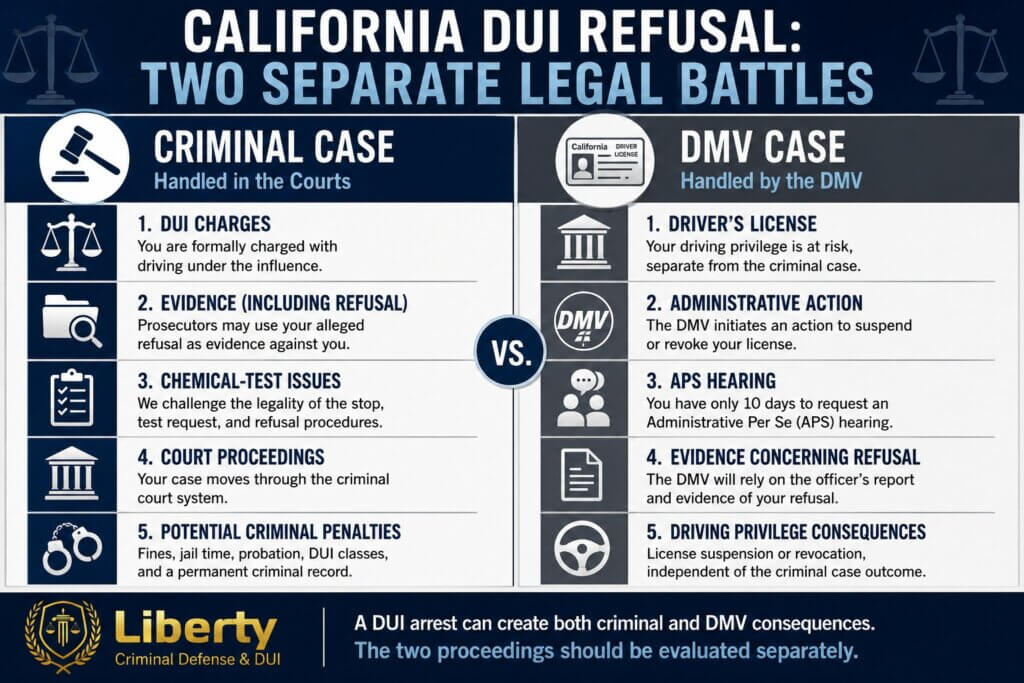
This is the piece that trips up the most people, and it’s worth discussing. Your DUI case and your DMV case are not the same proceeding, and winning one does not automatically resolve the other.
| Criminal DUI Case | DMV Proceeding |
| Handled through the criminal court | Administrative proceeding |
| Concerns criminal DUI allegations | Concerns driving privilege |
| Possible criminal penalties (fines, jail, probation) | Possible license suspension or revocation |
| Requires a criminal defense strategy | Requires a DMV/APS strategy |
| Separate from DMV action | Separate from criminal court |
It’s entirely possible to have your DUI charge dismissed or reduced in criminal court and still lose your license through the DMV, or vice versa. The standards of proof are different, the people deciding the outcome are different, and the timelines don’t run in sync. That’s exactly why a defense strategy needs to address both fronts from the start, not treat the DMV hearing as an afterthought once the criminal case wraps up.
What Are the Penalties for a DUI Refusal in California?
This is a section where a lot of online content oversimplifies things, so we are going to be more careful here. The actual consequences of a refusal allegation depend on several factors. For example, whether you have prior DUI or refusal history, whether the arrest itself was lawful, whether the required advisements were properly given, whether an actual refusal occurred as opposed to a misunderstanding, and which type of chemical test was involved.
With that caveat firmly in place, here’s the general framework under Vehicle Code § 13353 and § 13353.1, which govern DMV suspension periods for refusal:
- A first offense refusal generally results in a one-year license suspension, and unlike some standard DUI suspensions, a restricted license typically isn’t available during this period.
- A second offense within 10 years generally results in a two-year revocation.
- A third or subsequent offense within 10 years generally results in a three-year revocation.
These are general suspension periods, not a guarantee of what will happen in every case. Someone with no prior history facing a disputed refusal allegation is in a very different position than someone with two prior DUI convictions. The point isn’t to scare you with a worst-case number. It’s to make clear that the range is wide, and where your case falls within it depends on facts that need to be evaluated individually.
Can a DUI Refusal Be Challenged?
Yes, and this is where having someone who actually knows this area of law, like Evan Vargas at Liberty Criminal Defense & DUI, makes a real difference. An attorney reviewing a refusal allegation typically looks at a range of issues, including:
- Whether the officer had lawful grounds for the arrest in the first place
- Whether the implied-consent advisement was properly and clearly given
- Whether the driver actually refused, or whether the report doesn’t match what happened
- Whether the driver attempted to comply but couldn’t produce a valid sample
- Whether a medical condition affected the ability to complete testing
- Whether language or communication barriers played a role
- Whether the testing procedure itself followed required protocols
- Whether the evidence actually supports the officer’s written account
- Whether the DMV’s own administrative requirements were properly satisfied
- Whether certain evidence should be excluded or challenged on procedural grounds
Depending on the facts, any one of these can open the door to a defense. None of them guarantees a particular result, and it would be irresponsible to promise otherwise. What we can say is that refusal allegations get challenged successfully often enough that they deserve real scrutiny rather than being treated as settled fact.
What Should You Do After Being Accused of Refusing a DUI Test?
If you’re dealing with this right now, a few practical steps can protect you while you sort out next steps with an attorney.
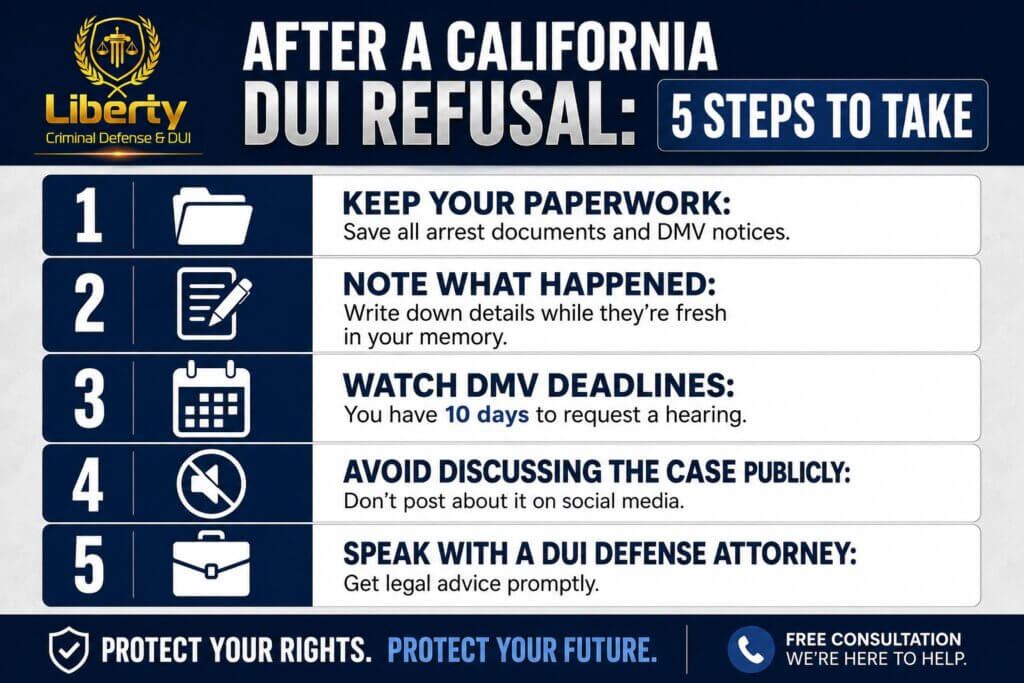
Don’t assume the refusal allegation is automatically accurate just because it’s written down. Officers make mistakes, and reports don’t always capture the full context. Hold onto any paperwork from the arrest, including the pink temporary license and any DMV notices you receive, since these documents carry the deadlines that matter most. Write down what you remember about the stop and the arrest while it’s still fresh, including anything about how the request for testing was communicated to you. Avoid discussing the details publicly, including on social media, since anything you post can end up being reviewed later. Pay close attention to DMV deadlines, because the 10-day window to request a hearing moves quickly and doesn’t offer much flexibility. And reach out to a qualified California DUI defense attorney as soon as you reasonably can.
None of this means destroying evidence, avoiding law enforcement, or being anything less than truthful. It means being organized and proactive about protecting your rights.
Frequently Asked Questions About DUI Refusal in California
Can you refuse a breathalyzer in California?
Before arrest, the roadside PAS breath test is generally voluntary for adult drivers. After a lawful DUI arrest, refusing the required evidentiary breath or blood test carries DMV and criminal consequences under implied consent law.
What happens if you refuse a DUI blood test?
Refusing a required blood test after a lawful arrest can trigger a DMV license suspension and can be used as evidence in your criminal case, similar to refusing a breath test.
Is refusing a DUI test a crime in California?
Refusal itself is treated as a violation of implied consent law, leading to administrative and enhanced criminal consequences rather than a standalone separate crime, but it can worsen the outcome of an underlying DUI charge.
Does refusing a chemical test automatically mean I will lose my license?
Not automatically. You can request a DMV hearing within 10 days to challenge the suspension, and the outcome depends on the specific facts of your arrest and the alleged refusal.
Can a DUI refusal be challenged?
Yes. An attorney can investigate whether the arrest was lawful, whether advisements were properly given, and whether an actual refusal occurred, among other factors.
What is an APS hearing?
An Administrative Per Se hearing is a DMV proceeding, separate from criminal court, where you can contest a license suspension related to a DUI arrest or refusal allegation.
Does a DUI refusal affect the criminal case?
It can. Prosecutors may try to use an alleged refusal as evidence suggesting consciousness of guilt, though this evidence can be challenged depending on the circumstances.
What if I was physically unable to provide a sample?
Medical conditions or physical limitations that prevented a valid sample can be relevant defenses. This is one of several factors an attorney would investigate.
What if the officer said I refused but I was trying to cooperate?
This is a common and legitimate dispute. Confusion, unclear advisements, or miscommunication can lead to a refusal being documented inaccurately, and this can be challenged.
Should I speak with a DUI defense attorney after a refusal allegation?
Yes. Because DMV and criminal deadlines move quickly and the consequences affect both your license and your criminal record, prompt legal advice is important.
Quick Reference
| Question | Key Point |
| Does California have implied consent? | Yes, by driving you agree to testing if lawfully arrested for DUI. |
| Can refusal have DMV consequences? | Yes, at least a 1-year license suspension for a first offense. |
| Can refusal affect a criminal case? | Yes, refusal can be used as evidence of consciousness of guilt. |
| Can an alleged refusal be challenged? | Yes, at a DMV hearing and in criminal court. |
| Are DMV and criminal proceedings separate? | Yes, they are two separate legal battles. |
| Should deadlines be taken seriously? | Yes, you have 10 days to request a DMV hearing. |
Why Choose Evan Vargas for Your DUI Defense?
Refusal allegations require a specific kind of attention that a general practice attorney doesn’t always bring to the table. Evan Vargas at Liberty Criminal Defence & DUI has spent years focused on DUI and refusal cases throughout Southern California, and that focus matters when you’re dealing with the overlapping deadlines and procedures of an implied-consent case.
Evan understands how California’s implied consent law and DMV procedures actually function in practice, not just on paper, which means he knows where refusal allegations tend to fall apart under scrutiny. He’s built a track record of pushing back on refusal claims and fighting to protect clients’ driving privileges at APS hearings, while simultaneously building a defense strategy for the criminal side of the case.
Every case gets individualized attention rather than a one-size-fits-all approach, because the facts of your stop, your arrest, and the alleged refusal are what actually determine the strategy. Liberty Criminal Defence & DUI offers free, confidential consultations for California DUI cases, so you can understand your options before making any decisions.
Book a Consultation with Liberty Criminal Defense & DUI
An alleged refusal doesn’t erase your rights, and it doesn’t automatically decide the outcome of your case. It does raise the stakes and shorten your timeline, since both the DMV and the criminal court have their own deadlines and procedures running at the same time. The sooner you understand what’s actually being alleged, and the sooner you get an experienced attorney reviewing the specifics, the more options you’ll have.
If you’re facing a DUI refusal allegation in California, don’t wait until the DMV deadline is nearly gone. Contact Liberty Criminal Defence & DUI to speak with Evan Vargas for a free confidential consultation about your case. No outcome can be guaranteed, but you deserve to understand your rights and your options before those deadlines pass.