

It’s late, and you see the lights in your rearview mirror before you’ve even decided how you feel about it. Maybe you had two drinks with dinner. Maybe you hadn’t had anything, but you’re tired and the officer says your eyes look glassy. Whatever brought you to the side of the road, one thought is probably running through your head right now: what happens next.
If you’re researching first-time DUI penalties, you’re already doing the right thing. A first offense in California is a misdemeanor for most drivers, and it is not the end of your life. But it is not nothing either. The state treats a first-time DUI offense seriously, and the penalties touch your finances, your driving privileges, and your record for years.
This is where a firm that focuses on DUI defense can make a real difference. At Liberty Criminal Defence & DUI, Senior Partner Evan Vargas has built his practice around exactly the moment when a driver needs someone who knows the system to explain what’s coming and how to push back on it. Below, we’ll walk through what the law actually says, what a conviction can cost you, and what you can do right now to protect yourself.
The Short Answer: First-Time DUI Penalties in California
For most first-time offenders, first-time DUI penalties in California start with jail exposure of up to six months, though judges lean toward probation far more often than they impose actual custody time. On the financial side, the base fine runs $390 to $1,000, and once penalty assessments are added, the real total typically climbs to $1,800 or more. Courts also place first-time offenders on probation for three to five years and suspend the license for four to six months. On top of that, DUI school is mandatory, and an ignition interlock device is generally required to drive during the suspension period. Any aggravating factor in the case pushes all of these penalties higher.
What Counts as a DUI in California
California law gives prosecutors two separate ways to charge you with driving under the influence, and it helps to understand both. Vehicle Code 23152(a) covers what’s called the impairment standard. It doesn’t require a specific blood alcohol number at all. If an officer believes alcohol or drugs affected your ability to drive safely, that alone can support a charge, even if your BAC comes back under the legal limit.
Vehicle Code 23152(b) is the “per se” law, and it’s the one most people think of first. If your BAC tests at 0.08% or higher, you’re presumed to be over the limit, full stop. The two charges often get filed together, which is one reason DUI charges in California can feel more complicated than they first appear.
The 0.08% threshold isn’t universal, though. It depends on who you are and what you’re driving.
BAC Limits by Driver Category
| Driver Category | BAC Limit |
| Standard adult driver (21+) | 0.08% |
| Commercial driver (CDL) | 0.04% |
| Driver under 21 | 0.01% (zero tolerance) |
If you’re a commercial driver or under 21, the margin for error shrinks considerably, and even a single drink can put you over the line.
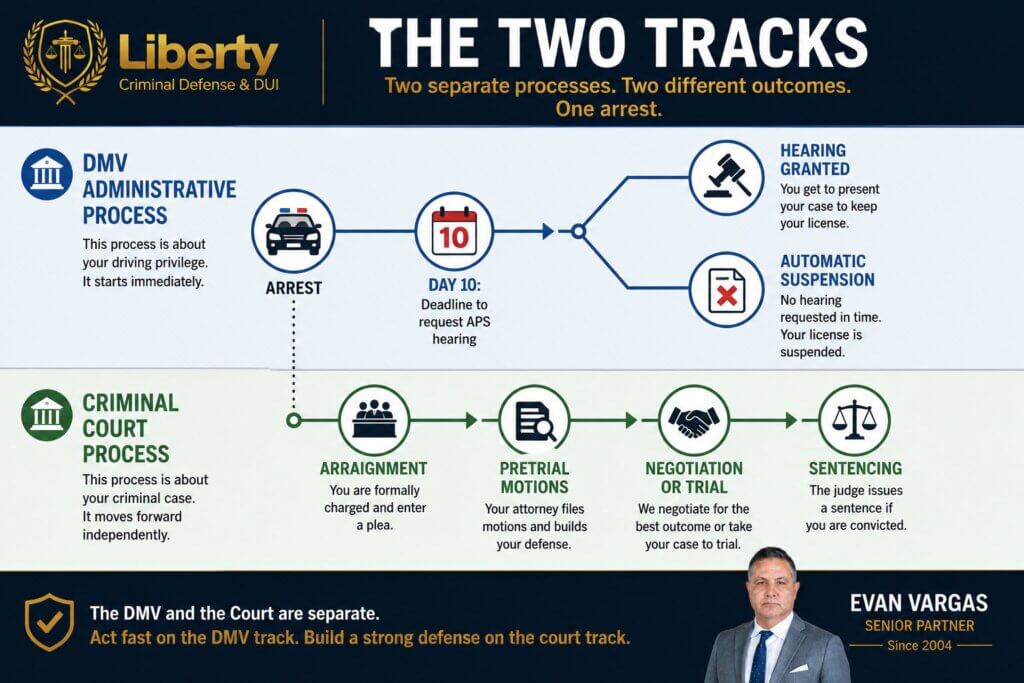
The Two Separate Proceedings: DMV and Criminal Court
Here’s something that catches a lot of first-time offenders off guard: a DUI arrest doesn’t lead to one case. It leads to two, and they run on different clocks with different rules.
The first is the DMV’s Administrative Per Se (APS) process. This is a civil action, separate from anything a judge decides, and its only job is to determine whether your license gets suspended. The second is the criminal case, which is where the jail, fines, and probation questions get decided. These two tracks move independently. You can win one and still face consequences in the other.
The DMV side moves fast. You have exactly 10 calendar days from the date of your arrest to request an APS hearing. Miss that window, and your license suspension typically becomes automatic, regardless of what eventually happens with the criminal charges. This is one of the more unforgiving parts of California DUI law, and it’s a major reason attorneys tell clients to call immediately after a DUI arrest rather than waiting to see how the criminal case shapes up.
Because these two proceedings run in parallel, the first-time DUI penalties you eventually face depend on outcomes in both. A strong DMV hearing can preserve your driving privileges even while the criminal case is still working its way through court. That’s part of why the 10-day deadline matters so much: it’s often the first real opportunity to fight back, and it closes quickly.
The Standard First-Time DUI Penalties
For a first offense with no aggravating factors, here’s what California law allows and what courts typically impose.
Standard First-Time DUI Penalties
| Penalty Element | Typical Range | Notes |
| Jail time | 48 hours to 6 months | Probation is common in place of actual jail |
| Fines | $390 to $1,000 base | Assessments push the real total to $1,800 to $4,000+ |
| Probation | 3 to 5 years | Informal (summary) probation for most first offenders |
| License suspension | 4 to 6 months | DMV and court suspensions can run concurrently |
| DUI school | 3 months (30 hours) | Extends to 9 months if BAC was 0.20%+ or test refused |
| Ignition interlock device (IID) | 6 months | Standard requirement to drive without restriction |
| SR-22 insurance | 3 years | Proof of financial responsibility filed with the DMV |
Let’s break each of these down in plain terms.
Jail is legally possible, but for most first-time offenders without aggravating circumstances, judges lean toward probation instead of actual custody time. That said, a minimum of 48 to 96 hours can be imposed depending on the county and the facts of the case, so it’s not something to assume away.
The fines look modest on paper. A $390 base fine sounds manageable. What catches people off guard is the pile of penalty assessments, court operations fees, and state surcharges layered on top, which routinely triple or quadruple the number you started with.
Probation for a first DUI usually runs three to five years, and it comes with conditions:
- don’t drive with any measurable alcohol in your system,
- don’t refuse a chemical test if you’re stopped again, and
- complete DUI school on schedule.
Violating probation can bring back the jail time a judge originally suspended.
License suspension works through both the DMV and the court, and the two suspensions typically overlap rather than stack. After an initial hard suspension period (commonly 30 days), most first-time offenders can apply for a restricted license that allows driving to work, school, or DUI programs.
DUI school is mandatory for nearly everyone. The standard first-offense program runs three months, but if your BAC was especially high or you refused testing, expect a longer nine-month program instead.
The IID requirement has become standard practice for first offenders under current California rules, generally for six months if you want to drive without restriction during your suspension period. And an SR-22 filing, essentially a certificate proving you carry the state-required minimum insurance, typically stays on your record for three years after a conviction.
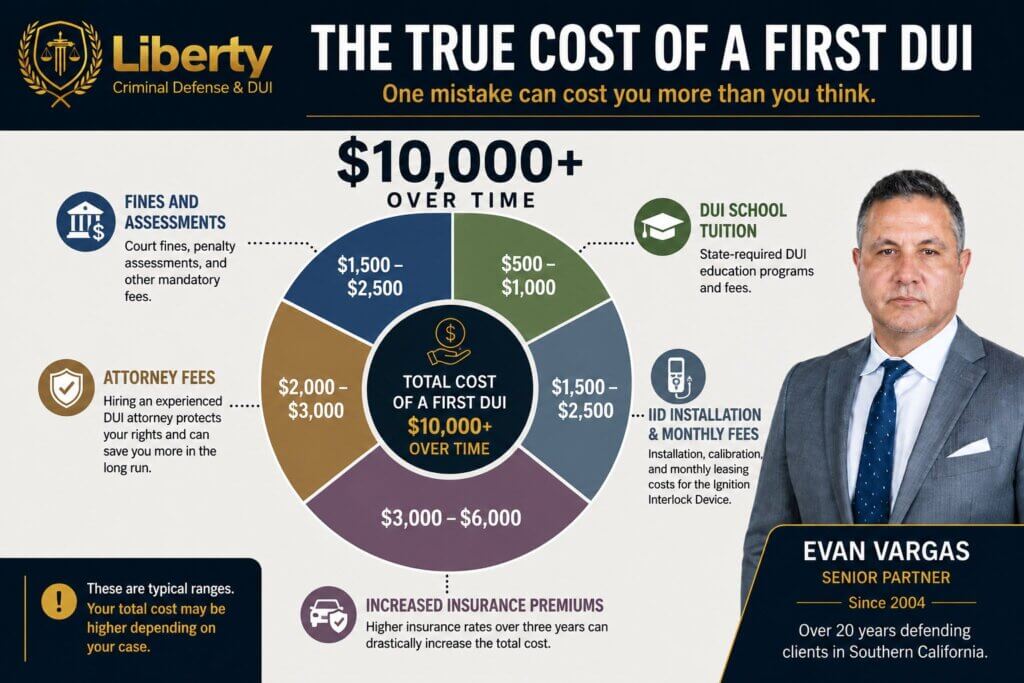
The real cost: Even a first offense can cost $10,000 or more once fines, assessments, DUI school, IID installation and monitoring, insurance increases, and attorney fees are added together.
These are the baseline first-time DUI penalties for a straightforward case. Add any aggravating factor, and the numbers move in the wrong direction quickly.
When Penalties Get Worse: Aggravating Factors
Not every first DUI looks the same to a court, and certain facts push a case out of the standard range entirely. Several circumstances commonly increase first-time DUI penalties beyond the baseline described above.
Aggravating Factors and Their Effect on Penalties
| Aggravating Factor | Typical Effect |
| BAC of 0.15% or higher | Longer DUI school, closer court scrutiny at sentencing |
| BAC of 0.20% or higher | DUI school extends to 9 months, higher fines likely |
| Refusing a chemical test | DMV suspension extends to about one year, separate penalties apply |
| Child passenger under 14 | Additional jail exposure and possible child endangerment charge |
| Accident causing injury | Case can be charged as a wobbler, filed as a felony |
A BAC that climbs well past the 0.08% line doesn’t just look worse to a jury, it triggers specific statutory consequences, particularly around the length of required DUI school. Refusing a breath or blood test after arrest carries its own separate penalty structure through the DMV, independent of whatever happens in the criminal case.
Having a child under 14 in the car adds mandatory additional custody time under Vehicle Code 23572, and it can also open the door to a separate child endangerment charge under Penal Code 273a, which is prosecuted on its own track.
Perhaps the most serious aggravating factor is an accident involving injury. California treats DUI causing injury as a “wobbler,” meaning prosecutors have discretion to file it as either a misdemeanor or a felony depending on the severity of the harm and the driver’s history. That distinction alone can be the difference between probation and state prison.
Your Rights and How to Protect Yourself
What you do in the hours after a stop matters almost as much as what happens afterward in court. A few points are worth knowing before you’re ever in that situation.
Field sobriety tests, the walk-and-turn, the one-leg stand, following a pen with your eyes, are voluntary in California. You can decline them politely. They’re subjective, officers are trained to look for signs of impairment whether or not they’re actually present, and declining doesn’t carry a separate legal penalty the way refusing a chemical test does.

Chemical testing is a different matter. Once you’re lawfully arrested, California’s implied consent law requires you to submit to a breath or blood test, and you generally get to choose which one. Refusing a post-arrest chemical test triggers its own penalties, including an extended DMV suspension, separate from whatever the underlying DUI charge results in.
What to do right after a DUI arrest:
- Stay calm and be polite, but don’t volunteer information
- Invoke your right to remain silent and ask for an attorney
- Write down what you remember as soon as you can: time, location, what the officer said, how the stop unfolded
- Request a DMV APS hearing within 10 calendar days
- Call a DUI defense attorney before you talk to anyone else about the case
- Stay off social media about the arrest until the case is resolved
That last point trips people up more than they expect. Prosecutors and insurance investigators do look at social media, and an offhand joke or photo can complicate a case that would otherwise have been straightforward. If you’ve just been through a DUI arrest, the safest move is to say as little as possible until you’ve talked to a lawyer.
Common Defenses a DUI Attorney Can Raise
A DUI arrest is not automatically a DUI conviction, and there are several angles an experienced defense attorney routinely examines before assuming the case is unwinnable.
Common DUI Defenses
| Defense | What It Challenges | Potential Outcome |
| Unlawful traffic stop | Whether the officer had legal grounds to pull you over | Evidence suppressed, case dismissed |
| Faulty or uncalibrated breathalyzer | Accuracy and maintenance records of the testing device | BAC result excluded or challenged |
| Rising blood alcohol | Whether your BAC was actually rising after driving, not at the time of driving | Charge reduced or dismissed |
| Improper blood draw | Whether the draw followed required medical and chain-of-custody protocols | Test results excluded |
| Mouth alcohol contamination | Whether residual substances skewed a breath test | BAC reading challenged |
| Medical conditions mimicking impairment | Whether a condition like GERD, diabetes, or fatigue explained the officer’s observations | Impairment element undermined |
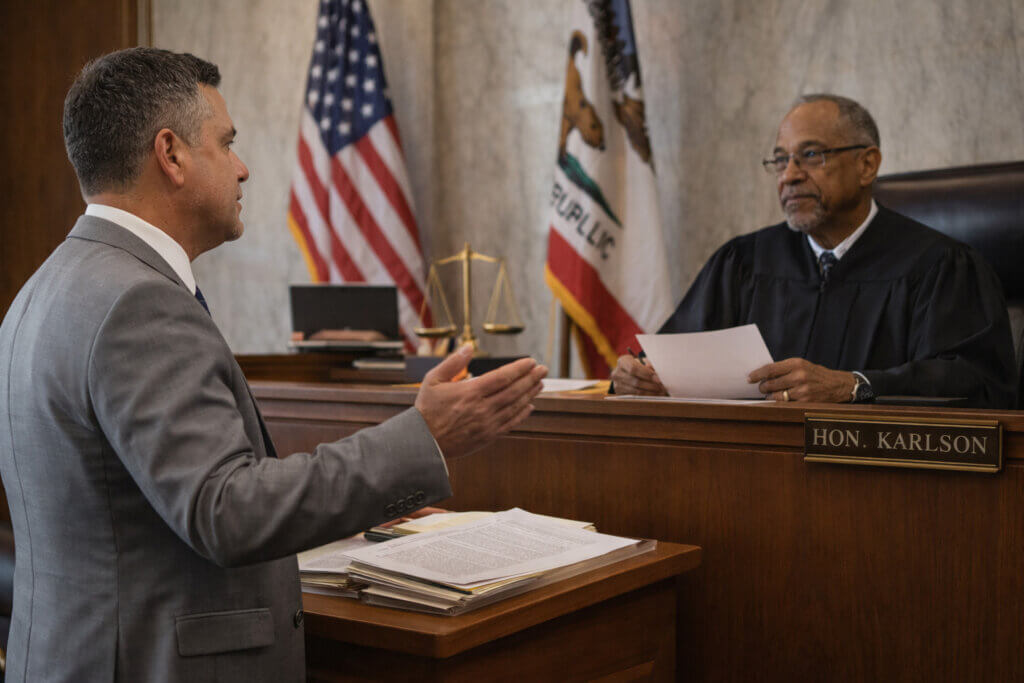
Every one of these defenses depends on the specific facts and paperwork behind your case, which is why the first step in any real defense is gathering everything the prosecution has. Evan Vargas begins every case by demanding full discovery, calibration and maintenance logs for the breath device, body camera footage, dispatch records, and the officer’s own notes, because the strength of a first-time DUI penalties case often lives or dies in details most drivers never think to ask about.
Long-Term Consequences of a Conviction
Beyond the immediate penalties, a DUI conviction follows you in ways that aren’t always obvious at the time of sentencing.
It becomes part of your criminal record, visible in most background checks for years. Insurance premiums typically rise substantially after a conviction and often stay elevated for three to five years, which can end up costing more over time than the court fines themselves. Some employers, particularly those requiring driving as part of the job, may reconsider your position, and certain professional licenses (nursing, teaching, commercial transport) can face review or added scrutiny.
California also uses a 10-year lookback period. Any DUI conviction within that window, including one from another state, can turn a future arrest into a second or third offense with substantially harsher penalties. This is factual, not a scare tactic: it’s simply how the statute is written, and it’s one more reason to take a first offense seriously from the start.
Frequently Asked Questions
Will I lose my license after a first DUI?
Likely, but usually not permanently. Most first-time offenders face a suspension of four to six months, with eligibility for a restricted license after an initial 30-day period, provided you request a DMV hearing in time.
Do I have to go to jail for a first DUI?
Not necessarily. Jail is legally possible for up to six months, but courts frequently impose probation instead for first-time offenders without aggravating factors like injury accidents or extremely high BAC levels.
Can a first-time DUI be reduced or dismissed?
Yes, depending on the evidence. Weak probable cause, testing errors, or procedural mistakes can lead to reduced charges like “wet reckless” or, in some cases, full dismissal.
How much does a first DUI cost in California?
Base fines run $390 to $1,000, but with assessments, DUI school, IID fees, and insurance increases, the realistic total for first-time DUI penalties often reaches $10,000 or more over several years.
Why should I hire a DUI attorney for a first offense?
An attorney can challenge evidence, negotiate reduced charges, protect your license at the DMV hearing, and help you avoid the harshest outcomes, options that are difficult to access without legal guidance.
Take the First Step Now
A first-time DUI in California carries real stakes: fines that add up fast, a license suspension that disrupts your daily life, and a record that can follow you for a decade or more. But it is also a situation where the right legal strategy makes a measurable difference, from DMV hearings to evidence challenges to negotiated outcomes that avoid the worst of the standard penalties.
Understanding first-time DUI penalties is the first step. Acting on that understanding, quickly and with the right help, is what actually protects your future. Evan Vargas and the team at Liberty Criminal Defence & DUI have guided drivers through first offenses and, when the facts call for it, far more serious felony DUI cases, and they know how to move fast on both the DMV and criminal court tracks.
If you or someone you care about was just arrested, don’t wait to see what happens. Contact Liberty Criminal Defence & DUI online for a free consultation, available 24/7, or call (909) 787-2073. The sooner you talk to a lawyer, the more options you have.
Legal Disclaimer: This article is provided for general informational purposes only and does not constitute legal advice. DUI and DWI laws vary by state, and the details here focus specifically on California law, which may not reflect the law in your jurisdiction or the specific facts of your case. If you have been arrested, speak with a licensed California DUI attorney about your situation before making decisions that affect your license or your case.