
If you were arrested for DUI in California in the last 48 hours, you probably have a hundred questions and a sick feeling in your stomach. What happens to your license? Will you go to jail? Do you have a criminal record now? Is there anything you can do?
Take a breath. You are not alone, and this is not hopeless.
A DUI arrest in California triggers two completely separate legal processes at the same time, and both have deadlines that start running immediately. Missing either one can make your situation much worse. In this article, we will walk you through exactly what happens after a DUI arrest in California, what you need to do right now, and how the system works from arrest to resolution.
What Happens Immediately After a DUI Arrest in California?
Most DUI cases start the same way: a traffic stop. A patrol officer pulls you over for something, whether it’s a lane violation, a broken taillight, or a checkpoint, and the interaction escalates from there.
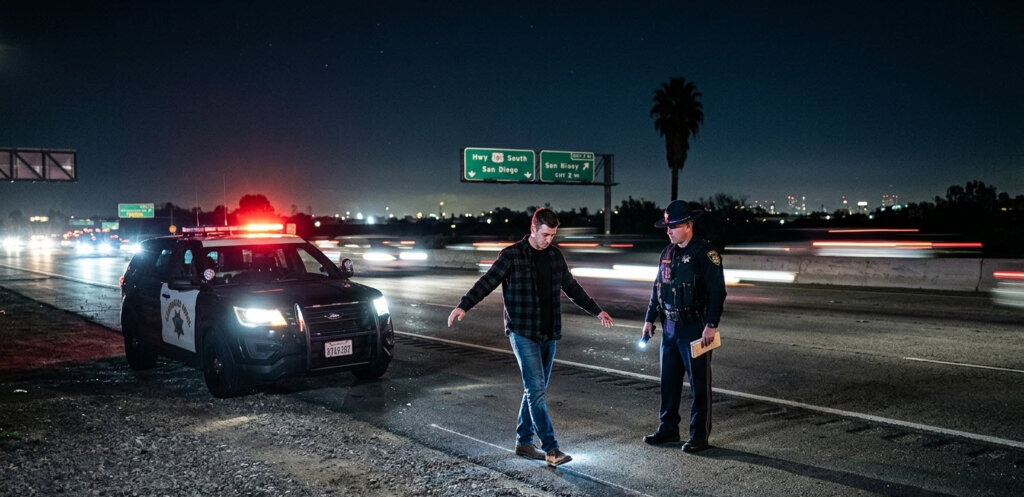
The sequence typically looks like this:
- The officer observes signs of impairment (slurred speech, smell of alcohol, bloodshot eyes)
- You are asked to perform field sobriety tests (you have the right to refuse these, though refusal may be noted)
- The officer asks you to take a preliminary alcohol screening (PAS) breath test at the roadside
- If results suggest impairment, you are placed under arrest
- You are transported to a jail or police station for booking
- A chemical test (evidentiary breath or blood) is administered under California’s implied consent law
- You are processed, held, and eventually released
The Roadside Crisis: The Stop and the “Appreciable Degree” Standard
The process usually begins with a traffic stop. In California, you can be charged under two primary theories of impairment. The first is The Roadside Crisis: The Stop and the “Appreciable Degree” Standard, California Vehicle Code 23152(a).
Under this law, the prosecution does not necessarily need a breath or blood test to prove you were impaired. Officers look for physical symptoms such as watery or bloodshot eyes, slurred speech, and an unsteady gait. If they believe your ability to drive safely was affected to an “appreciable degree” by alcohol or drugs, they can arrest you even if your blood alcohol concentration (BAC) was below the legal 0.08 percent limit.
Field Sobriety Tests (FSTs)
During the stop, the officer will likely ask you to perform coordination tests. These are highly subjective and are often used to build evidence against you. Many people do not realize that these tests are designed for failure, especially if you are nervous, tired, or have a physical condition that affects your balance.
The Per Se Limit: VC 23152(b)
The second common charge is California Vehicle Code 23152(b). This is a “per se” statute, meaning the evidence of a chemical test showing a BAC of 0.08 percent or higher is enough to convict you. You could be driving perfectly and obeying every traffic law, but if your test result is at or above that limit, the law presumes you are guilty of driving under the influence.
The Science of Your Defense: “Rising BAC”
One of the most effective scientific defenses is the “Rising BAC” defense. Alcohol takes time to be absorbed into your bloodstream. If you consumed your last drink shortly before being pulled over, your alcohol level might have been under the legal limit while you were actually driving.
Because it takes time for the police to transport you to the station and administer a chemical test, your BAC could have peaked during that delay. In these cases, the test result at the station does not accurately reflect your level of impairment at the time you were behind the wheel. Experienced DUI lawyers like Evan Vargas use forensic toxicology to dismantle the prosecution’s timeline and prove your innocence.
What the Booking Process Looks Like
Booking involves recording your personal information, photographing and fingerprinting you, and inventorying your belongings. For DUI arrests in Corona or Riverside, this is typically the Robert Presley Detention Center in downtown Riverside. Depending on the county, your BAC level, and whether there are aggravating factors like an accident or a high blood alcohol content, you may be released within a few hours on your own recognizance or you may need to post bail.
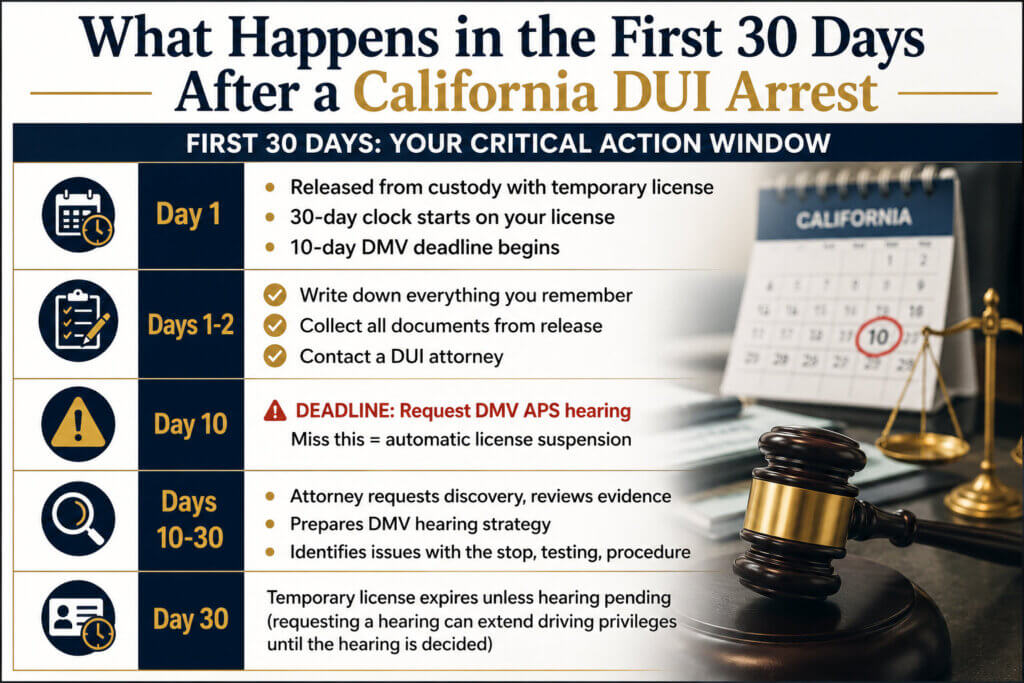
For a typical first-offense DUI with no injuries, most people are released within 4 to 12 hours. When you are released, the officer should hand you a pink or yellow temporary license and take your California driver’s license. That temporary license is good for 30 days.
Typical Timeline Following a California DUI Arrest
| Timeframe | What Happens |
|---|---|
| At the scene | Traffic stop, field sobriety tests, PAS breath test, arrest |
| Within 1–2 hours | Transport to jail or police station, booking |
| Within 4–12 hours | Release from custody (typical first offense, no injuries) |
| At release | Temporary license issued; physical license confiscated |
| Within 10 days | Critical deadline: Request a DMV APS hearing |
| Within 30 days | Temporary license expires (unless hearing is requested) |
| 30–90 days after arrest | First court date (arraignment) typically scheduled |
| 3–12 months | Case works through criminal court process |
Your Driver’s License Is at Risk Right Away
This is where a lot of people get blindsided. Your driver’s license is not just at risk in criminal court. The California DMV can suspend your license completely separately from anything a judge does.
When you were arrested, the officer confiscated your license and started an administrative process called the Admin Per Se (APS) suspension. The DMV gets notified automatically, and if you do nothing, your license will be suspended 30 days after your arrest.
The 10-Day Deadline You Cannot Miss
You have 10 calendar days from the date of your arrest to contact the DMV and request a hearing to challenge the suspension. If you miss this deadline, you lose your right to a hearing and the suspension goes into effect automatically.
This is one of the most important things you can do right after a DUI arrest, and it is something a DUI attorney can do on your behalf immediately after you hire them.
To request a hearing, call the DMV Driver Safety Office (not a regular DMV field office) that handles your county. Your attorney’s office can locate the correct number.
What Happens at a DMV Hearing?
The DMV hearing is not a criminal proceeding. A hearing officer (not a judge) reviews whether:
- The officer had lawful grounds to stop and arrest you
- You were lawfully requested to take a chemical test
- Your BAC was 0.08% or above, or you refused testing
You or your attorney can challenge any of these points. If you win, your license is not suspended through the DMV process. If you lose, the suspension timeline begins.
How Long Is the Suspension?
| Situation | First Offense | Second Offense (within 10 years) |
|---|---|---|
| BAC 0.08%+ | 4-month suspension | 1-year suspension |
| Refused chemical test | 1-year suspension | 2-year revocation |
(Source: California DMV, Admin Per Se Suspension)
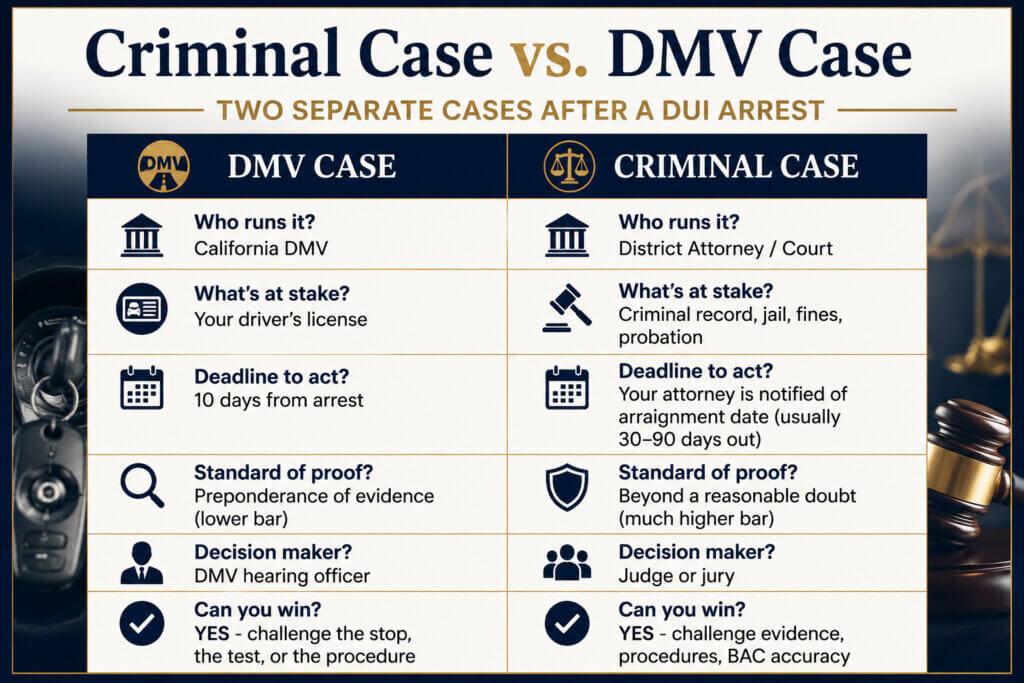
Key point: You can win at criminal court and still lose your license at the DMV, or vice versa. These cases run on separate tracks. You need to fight both.
What Should You Do After a DUI Arrest?
You have more control over what happens next than you probably realize right now. Here is a numbered action plan.
Your Post-Arrest Action Plan
- Request your DMV hearing within 10 days: Do not let this deadline pass. Call a DUI attorney today so they can do this for you.
- Write down everything you remember: While it is fresh, document exactly what happened. Where were you coming from? What did you drink, how much, and over what time period? What did the officer say? What tests did you do? What did you say? This becomes part of your defense.
- Keep every document you were given: Your pink or yellow temporary license, any paperwork from the jail, receipts, anything related to the arrest.
- Do not discuss the case on social media: Not a word. No vague posts about “rough nights” or photos from the evening. Prosecutors and investigators check social media.
- Do not talk about what happened with anyone other than your attorney: Well-meaning friends, family, and coworkers can become witnesses. Anything you say can be repeated.
- Show up to every court date: Missing a court date results in a bench warrant for your arrest and can make bail much worse.
- Avoid any new legal trouble: Any arrest while your DUI case is pending will complicate things significantly.
- Contact a California DUI lawyer immediately: Not next week. Today. The 10-day DMV deadline alone makes this urgent.
Understanding the Criminal Court Process
The criminal side of your DUI case runs through the California court system and can take anywhere from a few months to over a year to resolve. Here is what each stage looks like.
The Courtroom Battle: Arraignment and Negotiation
Your first court date is the arraignment. If you were arrested in Corona, your case will likely be heard at the Riverside Hall of Justice. The Corona Courthouse handles traffic infractions like speeding tickets but does not hear criminal DUI matters.
An experienced trial attorney like Evan Vargas uses this time to identify “cracks” in the police report. This might include:
- Challenging the legality of the traffic stop.
- Finding errors in breathalyzer calibration logs.
- Suppressing statements made if your Miranda rights were violated during custodial interrogation.
One common goal in negotiation is securing a “Wet Reckless” (VC 23103.5).” This is a reduced charge that carries lower fines, a shorter probation period, and no mandatory license suspension from the court.
Stages of a California DUI Case
| Stage | What Happens | Typical Timing |
|---|---|---|
| Arraignment | You are formally told the charges and enter a plea | 30–90 days after arrest |
| Pretrial Conferences | Attorneys exchange evidence, discuss potential resolution | Multiple dates over weeks/months |
| Discovery | Your attorney reviews police reports, dashcam, BAC results, officer records | Ongoing through pretrial |
| Pretrial Motions | Motions to suppress evidence, challenge the stop, or dismiss | Filed before trial |
| Plea Negotiations | DA may offer a reduced charge or favorable terms | Can happen at any stage |
| Trial | If no plea deal, case goes before a judge or jury | Months after arraignment |
| Sentencing | If convicted, judge imposes penalties | At or after trial |
The Arraignment
At your arraignment, you will enter one of three pleas:
- Not guilty: The most common choice, especially when you have just retained counsel. This preserves all your options.
- Guilty: A full admission. Rarely advisable before your attorney reviews the evidence.
- No contest (nolo contendere): Not admitting guilt but accepting the penalty. Used strategically in some cases.
Most attorneys will advise a not guilty plea at arraignment while they investigate the case thoroughly.
What Happens Between Arraignment and Trial?
This is where most cases actually get resolved. Your attorney requests discovery, meaning all the evidence the prosecution has. This includes the police report, dash and body camera footage, BAC test results, and records of the testing equipment’s calibration and maintenance.
Your attorney may file motions to suppress evidence if the officer lacked probable cause for the stop, administered tests improperly, or violated your rights in any way. If evidence gets suppressed, the prosecution’s case weakens. Many DUI cases get reduced or dismissed at this stage, not at trial.
Potential Penalties for a DUI Conviction in California
California DUI penalties stack up quickly, especially with prior offenses. Here is what you are looking at under California Vehicle Code Section 23152.
DUI Penalty Comparison Table
| Penalty | First Offense | Second Offense | Third Offense |
|---|---|---|---|
| Jail | 48 hours – 6 months | 96 hours – 1 year | 120 days – 1 year |
| Fines (with assessments) | $1,500 – $3,000+ | $1,800 – $3,500+ | $1,800 – $18,000+ |
| License Suspension | 6 months (criminal) | 2 years | 3 years |
| Probation | 3–5 years | 3–5 years | 3–5 years |
| DUI School | 3 or 9 months | 18 or 30 months | 30 months |
| Ignition Interlock Device | Required (varies by county) | Required (varies) | Required |
(Sources: California Vehicle Code §§ 23152, 23153, 23536–23548; California DMV)
Note: Fine amounts shown include mandatory penalty assessments and court fees, which can multiply the base fine by three to five times.
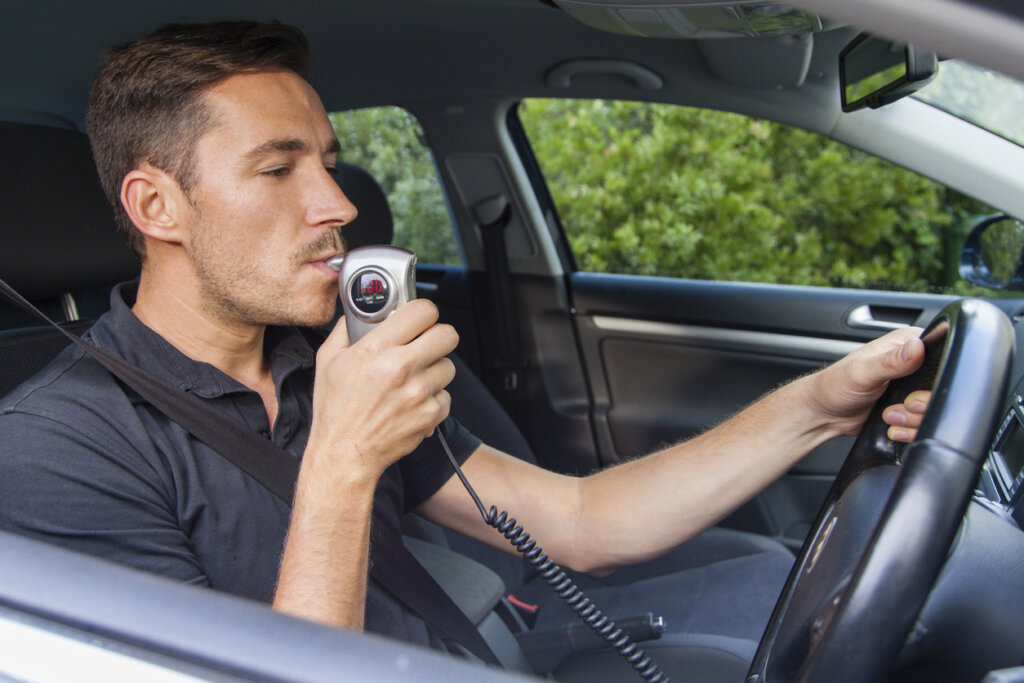
Ignition Interlock Devices (IID)
Under California law, courts can require an ignition interlock device after a DUI conviction. This is a breathalyzer installed in your car that you must blow into before the engine starts. You pay for the installation and monthly monitoring yourself. First-offense requirements vary by county, but SB 1046 (signed in 2018) expanded IID requirements significantly across California.
DUI Education Programs
Every DUI conviction in California requires completion of a state-licensed DUI education program. First offenders typically complete a 3-month (12-hour) program for a BAC under 0.20%, or a 9-month program for higher BAC levels. These programs cost money and time on top of everything else.
Factors That Can Make a DUI Case More Serious
Not all DUI charges are equal. Certain circumstances turn a misdemeanor DUI into a felony, or simply result in harsher sentencing.
High Blood Alcohol Content
Under California Vehicle Code § 23578, if your BAC was 0.15% or above, the court can impose enhanced penalties even on a first offense, including longer DUI school and additional jail time.
Accidents and Injuries
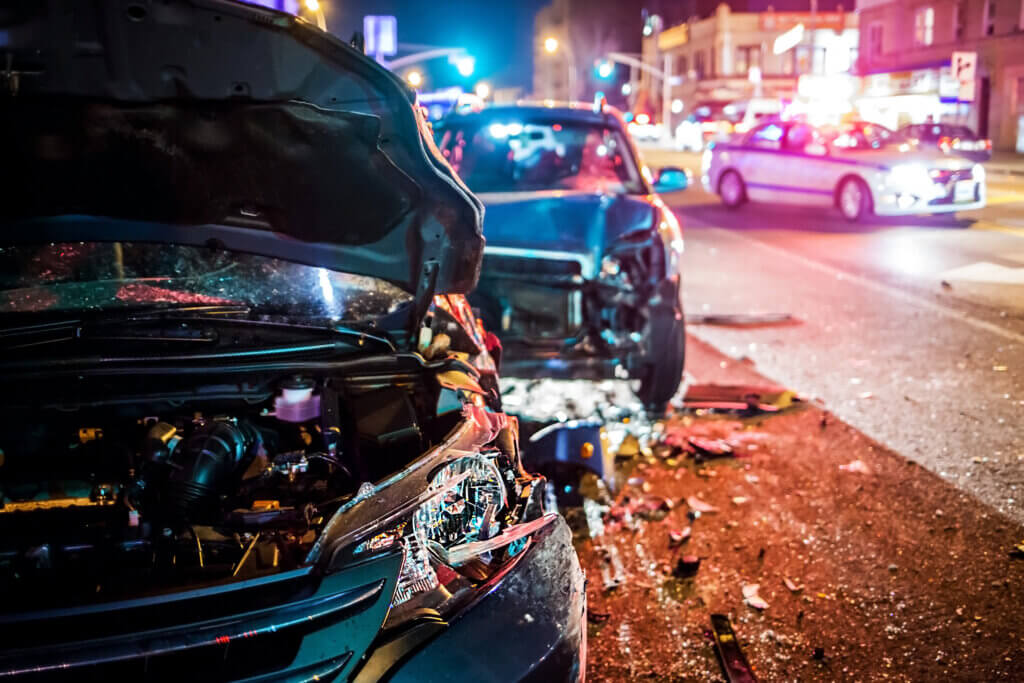
If someone was injured during a DUI incident, the charge becomes a “DUI causing bodily injury” under California Vehicle Code § 23153. Depending on the severity of the injuries and your prior record, this can be charged as either a misdemeanor or a felony. A death caused by a DUI can result in second-degree murder charges under California’s Watson murder doctrine (People v. Watson, 30 Cal.3d 290 (1981)).
Child Passengers
California Vehicle Code § 23572 adds 48 hours to 90 days in jail if a passenger under 14 years old was in the vehicle at the time of a DUI.
Refusing Chemical Testing
California’s implied consent law (Vehicle Code § 23612) means that by driving on California roads, you already consented to a chemical test after a lawful arrest. Refusing results in:
- An automatic 1-year license suspension for a first offense
- Enhanced criminal penalties if convicted
- The refusal being used as evidence against you at trial
Prior DUI Convictions
Any DUI conviction in California within the past 10 years counts as a “prior” and triggers escalating penalties. A fourth DUI offense, or any felony DUI, can result in state prison time rather than county jail.
How a California DUI Lawyer Can Help
Some people assume a DUI is an open-and-shut case because they failed a breath test. That is not accurate. DUI defense is a field that requires specific technical knowledge about how field sobriety tests are administered, how breathalyzers work (and fail), and how to challenge law enforcement’s procedures.
What a DUI Defense Attorney Actually Does
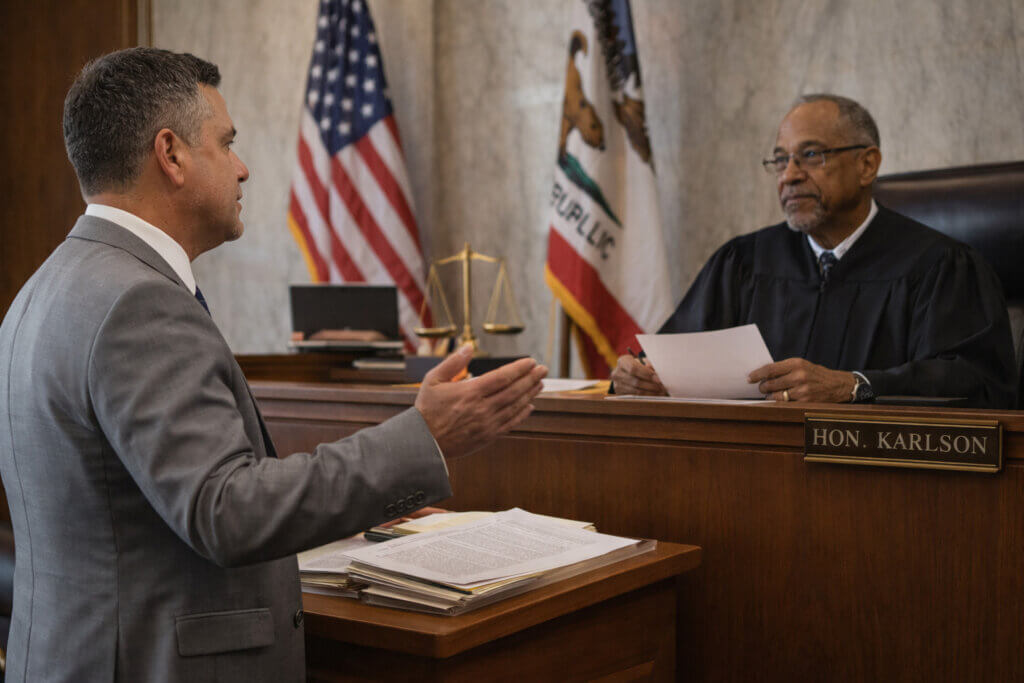
Reviews the traffic stop: The officer needed a specific, articulable reason to pull you over. If that reason doesn’t hold up legally, everything that came after might be suppressible.
Challenges the breathalyzer or blood test results: Breathalyzers require regular calibration and must be used correctly. Blood samples must be properly stored and handled to avoid fermentation or contamination. A DUI attorney knows what records to request and what to look for.
Handles the DMV hearing: Your attorney can appear at the DMV hearing on your behalf, examine the evidence, and make legal arguments to preserve your driving privileges.
Negotiates with the prosecutor: Many DUI cases get reduced to a “wet reckless” (reckless driving with alcohol) under California Vehicle Code § 23103.5, which carries lighter penalties and has fewer long-term consequences. This typically requires a skilled negotiator who has credibility with the local DA’s office.
Files pretrial motions: If the officer violated your Fourth Amendment rights during the stop, search, or testing, a motion to suppress can knock out key evidence and sometimes the entire case.
Represents you at trial: If the case goes to trial, you want someone who knows how to cross-examine law enforcement witnesses and present technical evidence to a jury.
Common Mistakes People Make After a DUI Arrest
These mistakes happen all the time, and they make already difficult situations worse.
Missing the 10-day DMV deadline: This is the single biggest mistake. Once you miss it, there is no appeal process. Your license suspension becomes automatic.
Ignoring court dates: A failure to appear results in a bench warrant, possible additional criminal charges, and the judge seeing you as someone who cannot be trusted. Courts take this seriously.
Posting on social media: Anything you post after your arrest can be used against you. Even a check-in at a bar two days before the arrest can be relevant. Stay off social media about anything related to the night of your arrest.
Waiting weeks to hire an attorney: The 10-day DMV deadline means you should have legal counsel within a day or two. An attorney who is hired weeks later has less time to gather evidence, request records, and prepare the DMV hearing.
Assuming the evidence is solid: People convince themselves there is nothing to fight because they “blew over the limit.” Breathalyzer results can be challenged. Procedures can be defective. Traffic stops can be unlawful. You do not know what the evidence looks like until an attorney reviews it.
Talking to police without a lawyer: After your arrest, you have the right to remain silent and the right to an attorney. Anything you say after your arrest can be used against you. Be polite, but do not provide more information than required.
Frequently Asked Questions
Will I lose my license immediately after a DUI arrest?
Not immediately, but the clock starts running the moment you are arrested. You get a temporary license that is valid for 30 days. If you request a DMV hearing within 10 days of your arrest, your driving privileges may be extended while the hearing is pending. If you do nothing, your license is automatically suspended when the 30 days are up.
What is the DMV hearing?
The DMV hearing is a separate administrative proceeding run by the California DMV, completely independent of your criminal case. A hearing officer reviews whether the officer had grounds to stop and arrest you, and whether your BAC tested at 0.08% or above (or whether you refused testing). You or your attorney can challenge the evidence. If you win, your license suspension through the DMV is set aside. This hearing must be requested within 10 days of your arrest.
Can DUI charges be reduced?
Yes. In California, a DUI can be reduced to a “wet reckless” under Vehicle Code § 23103.5. Prosecutors sometimes agree to this when the evidence is weak, the BAC was borderline, the defendant has no record, or defense counsel identifies legal issues with the case. A “wet reckless” carries lower fines, shorter DUI school, and a less severe impact on your record, though it can still count as a prior if you get another DUI within 10 years.
Do I need a lawyer for a first DUI in California?
You are not legally required to have an attorney, but hiring one is almost always worth it. Even a first DUI carries penalties that can affect your job, your insurance rates, your professional licenses, and your record. A DUI attorney can request the DMV hearing, gather evidence, identify weaknesses in the prosecution’s case, and negotiate with the district attorney. In many cases, an attorney achieves significantly better outcomes than people get by representing themselves.
What happens if I refuse a breath or blood test?
Under California’s implied consent law, refusing a chemical test after a lawful DUI arrest results in an automatic 1-year license suspension for a first offense (and longer for subsequent refusals). The refusal can also be used as evidence against you in criminal court. Chemical test refusals are typically treated more harshly in sentencing if you are convicted.
How long does a California DUI case take?
A typical first-offense misdemeanor DUI case in California takes between 4 and 12 months from arrest to resolution. Cases involving accidents, injuries, or prior convictions can take longer. The actual length depends on the county, the court’s schedule, how complex the legal issues are, and whether the case goes to trial.
Will a DUI stay on my record in California?
A DUI conviction in California stays on your criminal record permanently unless you seek an expungement under California Penal Code § 1203.4. An expungement does not erase the conviction entirely but removes it from public view in most contexts. For driving record purposes, the DMV keeps a DUI on your driving record for 10 years, and it counts as a prior offense during that window. A DUI conviction that results in prison time is not eligible for expungement.
Can I drive while my case is pending?
If you requested a DMV hearing within 10 days of your arrest, your temporary license is typically extended until the hearing is decided. If you did not request a hearing, your driving privilege is suspended 30 days after your arrest. During the suspension period, you may be eligible for a restricted license in some circumstances, which allows driving to and from work and DUI school. Your attorney can advise you on your specific options.
What Happens Next: A Summary and a Direct Word About Your Options
A DUI arrest in California sets off two parallel processes: one at the DMV and one in criminal court. Both have deadlines that start immediately. Both have real consequences if ignored. And both are processes where the outcome is not predetermined.
The 10-day DMV deadline is not flexible. The value of having legal counsel working on your case from day one, rather than week three, is real. Evidence gets gathered, records get requested, and the hearing gets scheduled while your recollection of events is still fresh.
You may be wondering whether any of this matters for your specific situation. That depends on the facts of your case, your prior record, the county you were arrested in, and a range of other factors that no article can fully address. What we can tell you is that people who do nothing consistently fare worse than people who act quickly and get competent legal help.
Contact Evan Vargas to Take Control of Your DUI Defense
With over 20 years of experience, Senior Partner Evan Vargas is a fixture in the Orange County, Riverside and San Bernardino courts. He doesn’t just “handle” cases (he dismantles them). Because every arrest is different, he takes the time to listen to your goals and build a strategy that reflects your unique story.
At Liberty Criminal Defense & DUI, we believe that one mistake should not define your life. We fight relentlessly on both the court and DMV fronts to protect your freedom, your family, and your future.
Take control of your defense. Do not wait for the prosecution to build its case. You only have 10 days to save your license. Contact Evan Vargas today for a free, confidential consultation at 909-787-2073.
Call us or reach out online today. Do not wait on the DMV deadline.
About the Author
| Evan Christopher Vargas is a Southern California native and Senior Partner at Liberty Criminal Defense & DUI Lawyers. With extensive experience handling misdemeanor and felony DUI cases, including injury cases and serious strike offenses. Evan has built a reputation for aggressive, strategic defense throughout Orange County, Riverside County, San Bernardino County, the Inland Empire, Los Angeles, and beyond. Read Evan’s full attorney profile. |
Legal Disclaimer: This blog post is intended for general informational purposes only and does not constitute legal advice. Reading this content does not create an attorney-client relationship. Laws change and individual circumstances vary. If you are facing a DUI charge in California, consult a licensed California attorney for advice specific to your situation.