

Your Criminal Record Doesn’t Have to Follow You: California’s Expungement Law Explained
A conviction shouldn’t follow you forever. California law gives you tools to fight back — here’s exactly how to use them.
You served your time. You paid your fines. You completed probation and rebuilt your life piece by piece. Yet every time you apply for a new job, a single line on a background report can undo years of hard work. This is what advocates call the “paper prison” — and California law gives you a real, substantive way out.
As a criminal defense attorney, Evan Vargas wants to be direct with you from the start: California does not erase records the way Hollywood might suggest. What the law provides is a court-ordered dismissal. This is a formal legal action that can dramatically reduce the impact of a prior conviction on your employment prospects, housing applications, and professional licensing pursuits. The laws have also shifted meaningfully in your favor over the past two years. With the full implementation of the Clean Slate Act, evolving court decisions on restitution, and increased judicial awareness of rehabilitation, 2026 may be the best window yet to pursue record relief. But favorable laws alone do not get cases resolved – effective advocacy does. This guide walks you through exactly what the law says, what has recently changed, and why having an experienced attorney in your corner matters more than ever.
What California “Expungement” Actually Means: PC 1203.4
A Dismissal, Not an Erasure
California Penal Code section 1203.4 governs what most people call expungement, but the statute’s language is precise: it provides for a dismissal of the conviction, not its removal from every record that exists. Understanding this distinction is fundamental to setting the right expectations and knowing what this relief can and cannot do for you. The conviction does not disappear from law enforcement databases or from the court’s own records. What changes is the legal status of the case and, critically, how private employers may treat it.
Many clients come to us having heard that expungement “wipes the slate clean.” Evan Vargas always takes time to correct that misconception, not to discourage them. He does this because going into this process with accurate expectations leads to better outcomes. The dismissal is a genuine and powerful legal tool. It simply works best when you understand precisely what it does.
How the Legal Mechanism Works
When a court grants relief under PC 1203.4, the following formal legal sequence is triggered. Each step has real significance — this is not merely a paperwork exercise:
- The case is formally re-opened by the court, giving the judge authority to act on the conviction.
- Your original guilty or no-contest plea is withdrawn — or if you were convicted at trial, the guilty verdict is set aside entirely.
- A plea of not guilty is entered in its place by the court, changing the official legal posture of the case.
- The court then dismisses the case in full, and the dismissal is noted in official court records.
This sequence matters legally because it allows you, when asked on a private employment application whether you have been convicted of a crime, to truthfully answer “no” with respect to that dismissed offense, in most circumstances. That single fact can change the course of a job interview, a rental application, or a professional opportunity.
The Employment Shield: Labor Code 432.7
California Labor Code 432.7 is the statute that gives the PC 1203.4 dismissal its practical teeth in the employment context. It prohibits most private employers from asking about, seeking information about, or using as a factor in any hiring decision a conviction that has been dismissed under PC 1203.4. When a third-party background check service surfaces a dismissed conviction, as they sometimes still do, the employer is generally barred from considering it. Violations of Labor Code 432.7 can expose employers to civil liability, which creates a meaningful incentive for compliance.
It is worth noting, however, that this protection applies to private employers. Public employers, law enforcement agencies, and certain state licensing boards operate under different rules — a distinction we explore in depth in the section below – “What a PC 1203.4 Dismissal Does Not Accomplish”. For the vast majority of people pursuing expungement with a private-sector job in mind, this employment protection is the primary goal and it is genuinely powerful.
Am I Eligible? The PC 1203.4 Checklist
Eligibility for relief under Penal Code 1203.4 turns on several key statutory requirements. Not every conviction qualifies automatically, and the details of your specific case, for example, the charges, the sentence imposed, how probation was handled, all matter. Here is a plain-language breakdown of the primary criteria courts evaluate:
- Probation Was Granted and Completed. The statute’s primary pathway applies to individuals who received a probationary sentence and successfully fulfilled all of its terms. This means paying all fines and fees on schedule, completing any required community service hours, attending mandated counseling or classes, and remaining law-abiding throughout the entire probationary period. Courts look at the totality of your compliance, not just one or two conditions.
- No Current Charges or Active Sentence. The petition cannot be filed while you are currently charged with another offense, actively serving a sentence, or on probation or parole for any other matter. You must be in a clean legal posture at the time of filing. Even a pending traffic infraction that has escalated to a misdemeanor could complicate your petition’s timing.
- No State Prison Sentence on the Conviction. Generally, PC 1203.4 relief is unavailable to individuals who were sentenced to California state prison for the underlying offense. However, this exclusion does not apply to felony convictions that resulted in a county jail sentence under AB 109 (Criminal Justice Realignment). Those may still qualify, but the analysis is fact-specific and requires a careful review of the original sentencing documents.
- No Categorical Statutory Exclusions. Certain offenses are explicitly excluded from PC 1203.4 relief by statute, most notably serious sex offenses requiring lifetime registration under Penal Code 290. If your conviction falls into one of these excluded categories, expungement through the standard 1203.4 pathway is not available, and alternative forms of relief — such as a Certificate of Rehabilitation or a Governor’s Pardon — would need to be explored.
The “Interest of Justice” Discretionary Pathway
This is where an experienced attorney earns their value. The statute draws a clear distinction between those who completed probation successfully and those who did not, but it does not flatly bar relief for the latter group. If you did not complete probation perfectly due to a technical violation, a missed payment due to financial hardship, or a late completion of a required program, the court still retains discretionary authority to grant relief in the “interest of justice.”
This discretionary pathway is not automatic. The argument must be made persuasively, with evidence. A skilled attorney will build a compelling record showing the nature of the violation, the circumstances that caused it, the petitioner’s conduct and contributions since then, and the concrete ways in which a dismissal would serve the public interest. Judges respond to well-crafted narratives backed by documentation such as letters from employers, proof of community involvement, or evidence of stability. It is a genuine legal argument, and courts grant it regularly when it is properly presented.
Critical Legal Updates: The 2024–2026 Landscape
The law governing record relief in California has evolved more rapidly in the past two years than in the prior decade combined. Staying current on these changes is not optional — it is the difference between a petition that succeeds and one that misses a critical legal argument or fails to account for an available form of relief.
The Clean Slate Act: Automatic Record Sealing
Senate Bill 731, California’s Clean Slate Act, represents the most sweeping shift in record relief law in a generation. The legislation directed the California Department of Justice to begin automatically sealing certain categories of criminal records without requiring individuals to navigate a court petition on their own. The policy rationale is straightforward: research consistently shows that individuals with criminal records face dramatically lower employment rates, not always because employers make conscious decisions to discriminate, but often simply because background check results trigger automatic screening filters before a human ever reviews the application.
Why You Still Need a Lawyer Even Under SB 731
Automatic sealing sounds like a complete solution — but in practice, it frequently is not. Here is what the law does not fully address on its own. First, DOJ-level sealing does not always propagate immediately — or accurately — to county-level court records, local law enforcement agency databases, or the private third-party background screening companies that most employers actually use. A record sealed at the state level can still appear on a background check run through a commercial screening provider that has not updated its database.
Second, serious and violent felonies, as well as certain other excluded offense categories, remain explicitly outside the scope of SB 731’s automatic provisions. Those individuals still require a formal petition. Third, when an individual needs to verify that their record has actually been sealed — and to correct any databases that have not reflected the change — that follow-up work requires knowing exactly where to look, how to submit correction requests, and what legal remedies exist if a background check company fails to comply. An experienced attorney can handle all of this proactively, rather than leaving you to discover the problem only when a job offer falls through.
Recent amendments to Penal Code 1203.4(c)(3) and emerging case law have significantly curtailed courts’ ability to deny an expungement petition solely because a petitioner still owes outstanding victim restitution. This is a meaningful development for lower-income individuals who have genuinely turned their lives around but cannot fully satisfy the financial component of their sentence. Courts must now engage in a more holistic evaluation of the petitioner’s circumstances rather than using unpaid restitution as a categorical barrier. While restitution obligations remain enforceable through other civil and criminal legal channels, the inability to pay in full is no longer an automatic disqualifier for record relief and that change opens the door for many people who previously assumed they were ineligible.
What a PC 1203.4 Dismissal Does Not Accomplish
Candor is a cornerstone of effective legal representation. Evan Vargas believes that part of his job as your attorney is to give you an honest picture, not just the good news, but the full picture. A PC 1203.4 dismissal is one of the most useful legal tools available to Californians with a criminal record, but it is not a universal reset button. Knowing its limits lets you plan accordingly and pursue additional remedies where necessary.
Government Jobs & Licensing Boards
If you are applying for a government position or a state-issued professional license, for example, nursing, real estate, contracting, law, you will generally still be required to disclose a dismissed conviction when the application directly asks about it. Licensing boards such as the California Board of Registered Nursing, the Department of Real Estate, and the State Bar retain authority to review your history and weigh it against their fitness standards. Failing to disclose when required can itself become a ground for denial. The better strategy is honest disclosure paired with a strong mitigation narrative, ideally prepared with legal guidance.
Firearm Rights Not Restored
A PC 1203.4 dismissal does not, as a general rule, restore your right to own or possess firearms if that right was lost as a result of your conviction. Restoring firearm rights in California requires a separate legal proceeding, and the analysis involves both state and federal law. Anyone with questions about their specific situation should consult with an attorney before taking any action involving firearms since the consequences of error are severe.
Federal Immigration Consequences
For non-citizens, this limitation deserves particular emphasis: federal immigration law generally does not recognize a California state court dismissal as eliminating the immigration consequences of the underlying conviction. Deportability, inadmissibility, and bars to naturalization are governed by federal law, and a state-level dismissal does not override federal determinations. Non-citizens should consult with both a criminal defense attorney and an immigration attorney before filing any petition because the interaction between state and federal law in this area is complex and the stakes are high.
Future Criminal Sentencing
If you are charged with a new crime in the future, a dismissed conviction can still be used by a prosecutor to seek sentencing enhancements or to establish a pattern of conduct. The dismissal benefits you in the employment context and allows you to answer most private-sector job applications honestly, but it does not wipe the record clean for purposes of recidivism sentencing in future criminal proceedings. This is one more reason why staying out of legal trouble after an expungement is so important.
The Process: What Happens Behind the Scenes
Filing a PC 1203.4 petition is not as simple as downloading a form and mailing it to the courthouse. The process involves multiple procedural stages, statutory deadlines, and strategic decisions at each turn, all of which benefit from experienced handling. Here is what a properly managed expungement case looks like from start to finish:
Case Research & Record Retrieval
Before filing anything, a thorough attorney pulls your full criminal history, often called a “rap sheet,” along with the court dockets and minute orders from the county or counties of conviction. This review confirms the exact charges, the legal disposition of each count, the probation conditions that were imposed, and whether all terms appear to have been satisfied on the official court record. Discrepancies between what actually happened and what the record shows are not uncommon. For example, probation completion dates may have been entered incorrectly, fines marked as unpaid when they were paid, conditions listed as incomplete when documentation exists proving otherwise. Identifying and correcting these discrepancies early is critical to avoiding unnecessary delays or denials.
Preparing & Filing the Petition (Form CR-180)
The formal petition is filed in the Superior Court of the county where the conviction occurred, using Judicial Council Form CR-180. While the form itself is a standardized document, what accompanies it can make an enormous difference in the outcome. In cases that turn on the court’s discretionary “interest of justice” determination, a well-crafted supporting declaration that documents rehabilitation, community ties, employment history, and the concrete ways in which the dismissal would serve both the petitioner and the public, can be the deciding factor. Your attorney should treat this declaration as a legal brief, not an afterthought.
The DA’s 15-Day Response Window
Once the petition is filed, the District Attorney’s office has 15 days to review it and file a formal objection if they choose to do so. In straightforward cases, such as an uncontested misdemeanor where probation was fully completed, prosecutors frequently do not file an objection, and the matter may be resolved without a hearing. In more contested matters, particularly for felony convictions, older cases, or petitions relying on the interest-of-justice discretion, a DA objection is more common. Your attorney should be prepared for this possibility from the outset and have a responsive argument ready to deploy.
The Hearing: Where Advocacy Matters Most
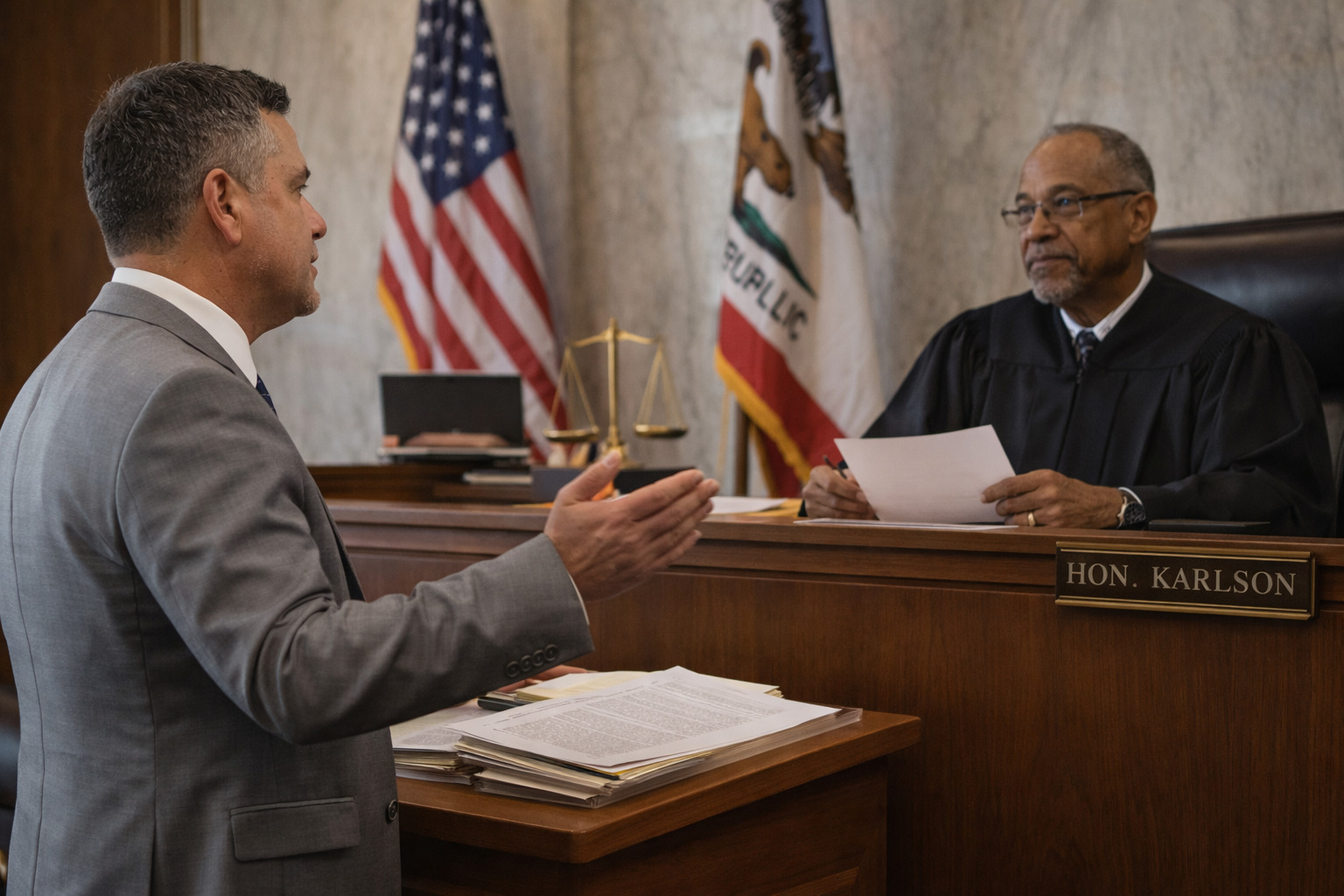
When a hearing is scheduled, either because the petition is contested or the judge wants to address it on the record, this is where the quality of legal representation becomes most visible. The attorney presents your case to the judge, frames the narrative of rehabilitation and changed circumstances, responds to any prosecutorial objections with legal authority and factual evidence, and addresses the court’s own concerns directly. An attorney who knows the local Superior Court, the assigned judge’s priorities, and the county DA’s typical posture on expungement matters can anticipate challenges and navigate them with precision. After the court grants the petition, certified copies of the dismissal order should be obtained and distributed to relevant agencies to trigger the record update process.
Strategic Advice: The Attorney’s Edge
Beyond the mechanics of the petition itself, there are strategic approaches that an experienced California criminal defense attorney can deploy to maximize the benefit of your expungement. Two of the most impactful are the Wobbler strategy and deliberate timing.
The Wobbler Strategy: Double the Protection
If your felony conviction is what California law calls a “wobbler”, which is an offense that could have been charged as either a felony or a misdemeanor under the applicable statute, there is a powerful two-step strategy that dramatically amplifies the benefit of expungement. Before or simultaneously with filing the PC 1203.4 petition, we file a motion under Penal Code 17(b) to reduce the felony to a misdemeanor. Courts have discretion to grant this reduction based on factors including the nature of the offense, your conduct during and after probation, and the overall circumstances of the case. Once the court grants the 17(b) reduction, we proceed immediately with the dismissal under PC 1203.4. The result: what was once a felony conviction becomes, in legal terms, a dismissed misdemeanor. This double-step approach offers substantially greater protection in employment screening, professional licensing applications, certain federal collateral consequences, and in how the conviction can be used in any future criminal proceedings. Many people pursuing expungement entirely on their own are completely unaware this option exists and that gap in knowledge can cost them years of unnecessary exposure.
The Importance of Strategic Timing
Filing a petition too early, before all probation conditions are verifiably complete and documented, risks outright denial and can create additional procedural complications for a re-filing. Courts that deny a petition are not required to simply allow an immediate re-submission; depending on the grounds for denial, a waiting period or corrective steps may be required. The cost of moving too quickly can be months of delay.
Equally important is county-specific intelligence. California’s 58 counties have different court cultures, different DA’s office practices, and different individual judges with different inclinations on expungement matters. An attorney with experience in the specific county where your case was adjudicated can calibrate the timing, the tone of the petition, the supporting documentation included, and the oral argument strategy to align with what that particular court responds to. This localized knowledge is one of the most underappreciated advantages of working with experienced local counsel rather than a high-volume online expungement service that treats every case identically regardless of jurisdiction.
After the Dismissal: Protecting Your New Legal Status
Obtaining the dismissal order is the beginning, not the end. Once the court grants your petition, several follow-up steps are important to ensure the relief actually reflects in the databases that matter. The court will transmit the dismissal to the California DOJ, which should update the state rap sheet. However, commercial background screening companies, the ones most employers actually use, may not update their records automatically or promptly. Monitoring your background check report in the months following a dismissal, and knowing how to submit formal correction requests to screening companies that continue to report the old conviction status, is an important part of making your expungement practically effective, not just legally effective.
Ready to Take Control of Your Future?
Attorney Evan Vargas at Liberty Criminal Defense & DUI has helped clients across California navigate the expungement process, reduce felonies under PC 17(b), and reclaim their careers and their lives. The laws are more favorable than they have ever been but the process still requires precision. Don’t let a background check define the rest of your story.