
Disclaimer: This article provides general legal information and does not constitute legal advice. For legal advice about your specific case, contact Liberty Criminal Defense & DUI.
Many people facing domestic violence charges believe the case will simply disappear if the alleged victim decides to take back their statement. This assumption, while understandable, misunderstands how the criminal justice system operates. When someone recants, meaning they withdraw or contradict their original accusation, prosecutors may not automatically close the file and walk away.
This article explains why a victim’s recantation may not end a domestic violence prosecution, what evidence the state relies upon beyond the victim’s testimony, and what defendants should understand about their legal situation. Whether you are a defendant, a family member seeking answers, or someone researching how recantation affects criminal cases, this information will help clarify a frequently misunderstood area of criminal law. For guidance tailored to your circumstances, contact Evan Vargas at Liberty Criminal Defense & DUI for a free confidential consultation.
Background: Victim Recantation Defined
Recantation occurs when a person who made an earlier statement, typically to police, in a sworn affidavit, or during testimony, later withdraws, contradicts, or disavows that statement. In domestic violence cases, a victim might recant by telling prosecutors they no longer wish to pursue charges, by claiming the original report was exaggerated or false, or by refusing to appear as a witness.
When and Why Victims Recant
Research indicates that victim withdrawal or recantation happens frequently in intimate partner violence cases. A comprehensive study conducted by the King County Prosecuting Attorney’s Office found that a significant portion of domestic violence victims disengage from the prosecution process at some point before trial, with many doing so within weeks of the initial report.
Victims recant for many reasons, including:
- Fear of retaliation: Concern that the defendant will become more violent if prosecution continues.
- Economic dependence: Reliance on the defendant for housing, income, or childcare.
- Emotional attachment: Ongoing love, hope for reconciliation, or belief the defendant will change.
- Family pressure: Influence from relatives, children, or community members to drop the matter.
- Intimidation or coercion: Direct or indirect pressure from the defendant or associates.
- Distrust of the system: Negative past experiences with law enforcement or courts.
According to Evan Stark in his paper “Coercive Control” (2007), understanding these dynamics is essential. Prosecutors, judges, and juries increasingly recognize that recantation is often a predictable part of the cycle of abuse rather than evidence that no crime occurred.
Prosecutorial Discretion and the Public Interest
“Criminal charges belong to the state, not the individual victim. Prosecutors decide whether public safety and justice require moving forward, regardless of what the victim wants.”
A foundational principle of American criminal law is that the state, not the private citizen, brings and controls criminal prosecutions. When police respond to a domestic violence call and make an arrest, the matter becomes a case between the government and the accused. The victim is an important witness, but they do not have the legal authority to “drop charges.”
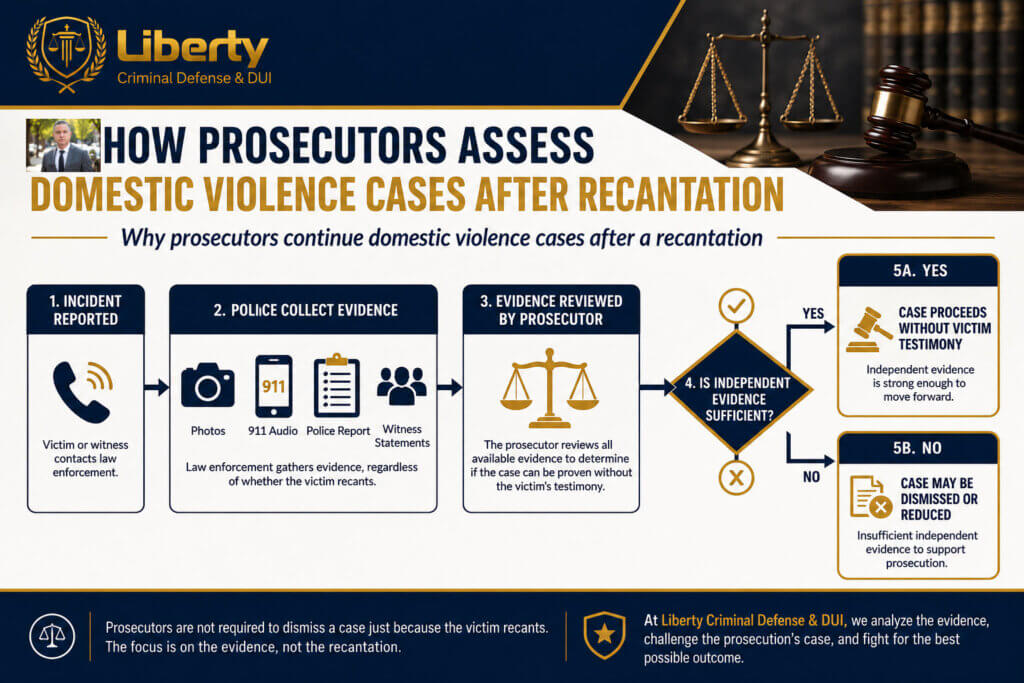
Prosecutors exercise discretion in deciding whether to file charges, continue a case, offer a plea agreement, or dismiss. This discretion is guided by several factors:
- Strength of the evidence: Is there sufficient proof to establish guilt beyond a reasonable doubt?
- Public safety: Does the defendant pose a continuing threat to the victim or community?
- Prior history: Has the defendant been involved in previous domestic violence incidents?
- Policy considerations: Many jurisdictions have adopted “no-drop” or “evidence-based” prosecution policies for domestic violence cases.
Even when a victim expresses a desire to withdraw, prosecutors may conclude that public interest and available evidence justify proceeding. This approach reflects decades of research showing that domestic violence is a serious public health and safety concern, and that leaving prosecution decisions solely to victims can expose them to further harm.
Evidence Beyond the Victim’s Statement
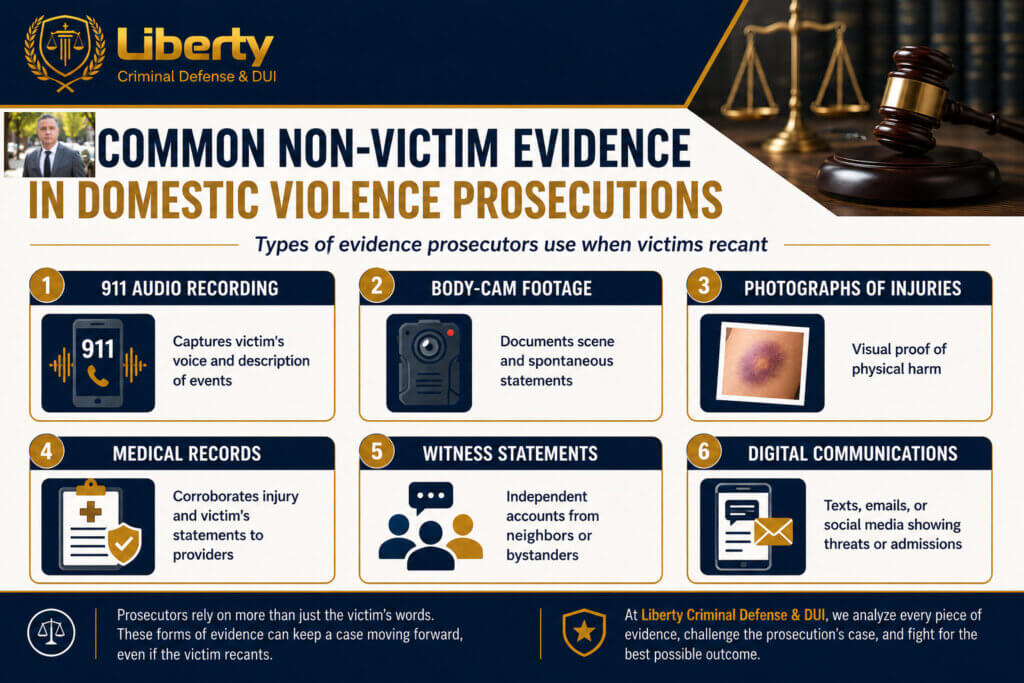
Prosecutors anticipate that victims may become reluctant or recant entirely. As a result, they try to build cases using multiple independent sources of evidence that do not depend on victim cooperation.
Types of Independent Evidence
911 Recordings:
Calls made during or immediately after an incident often capture the victim’s distressed voice, descriptions of violence, and background sounds. Courts frequently admit these recordings under the “excited utterance” hearsay exception because statements made under the stress of a startling event are considered inherently reliable.
Body-Worn Camera Footage:
Many police departments now equip officers with body cameras. This footage documents the scene, the victim’s demeanor, visible injuries, and spontaneous statements made upon police arrival.
Photographs of Injuries:
Officers routinely photograph bruises, cuts, swelling, and other physical evidence. Medical professionals may also document injuries during treatment.
Medical Records:
Emergency room visits, urgent care records, and statements made to healthcare providers can corroborate that an assault occurred. Statements made for purposes of medical diagnosis or treatment are often admissible as another hearsay exception.
Witness Statements:
Neighbors, family members, or bystanders who heard or saw parts of the incident can provide testimony independent of the victim.
Text Messages and Digital Communications:
Threatening or apologetic messages from the defendant, pleas from the victim, or communications describing the abuse can serve as powerful evidence.
Prior Incidents and Criminal History:
Evidence of previous domestic violence, protective orders, or patterns of abusive behavior may be admissible to establish motive, intent, or a continuing course of conduct.
Evidence Types in Domestic Violence Prosecutions
| Evidence Type | Collected By | Use in Prosecutor’s Case |
| 911 Recordings | Dispatch center | Documents victim’s statements and emotional state during/after incident; often admissible as excited utterance |
| Body-Cam Footage | Responding officers | Shows scene, injuries, victim demeanor, and spontaneous statements |
| Photographs | Police, medical staff | Visual proof of physical injuries |
| Medical Records | Hospitals, clinics | Corroborates injury claims; statements for diagnosis often admissible |
| Witness Statements | Police interviews | Independent accounts of what occurred |
| Text Messages/Digital Evidence | Subpoenas, phone extraction | Shows threats, admissions, or pattern of abuse |
| Prior Incident Reports | Law enforcement databases | Establishes history and pattern of violence |
Victimless or Evidence-Based Prosecution
When a victim refuses to cooperate or recants, prosecutors may pursue what is sometimes called “victimless prosecution” or “evidence-based prosecution.” This approach relies on the independent evidence described above to prove the case without requiring the victim to testify against the defendant.
How It Works
Prosecutors present 911 recordings, photographs, medical records, officer testimony, and other evidence to establish what happened. Expert witnesses, such as domestic violence counselors or forensic psychologists, may testify to help jurors understand why victims often recant and why recantation does not necessarily mean the original report was false(for more information, please refer to the academic article by Epstein, Deborah. “Procedural Justice: Tempering the State’s Response to Domestic Violence,” William & Mary Law Review, 2002).
Legal and Ethical Limits
Evidence-based prosecution must still comply with constitutional requirements. The Sixth Amendment’s Confrontation Clause gives defendants the right to confront witnesses against them. This means prosecutors cannot simply read a victim’s written statement to the jury if the victim does not testify, unless specific legal exceptions apply.
Key exceptions include:
- Excited utterances: Statements made under the immediate stress of a startling event (such as a 911 call moments after an assault) are generally admissible.
- Statements for medical treatment: Statements made to healthcare providers for diagnosis or treatment purposes.
- Forfeiture by wrongdoing: If the defendant caused the victim’s unavailability through intimidation or threats, the defendant may forfeit the right to exclude the victim’s prior statements.
“Prosecutors have learned to anticipate recantation. The strongest domestic violence cases are built on evidence that stands alone, even if the victim may never say another word.”
Why Prosecutors Distrust Recantations
Experienced prosecutors approach recantations with skepticism, not because they disbelieve victims, but because research and courtroom experience demonstrate that recantation is often a product of the abuse itself.
Factors That Raise Concern
- Timing: Recantations that occur shortly after the defendant posts bail or resumes contact with the victim may suggest pressure or coercion.
- Inconsistency: When the recantation contradicts strong physical evidence (photographs, medical records), prosecutors question its reliability.
- Pattern: If a victim has recanted in previous incidents involving the same defendant, prosecutors recognize a recurring cycle.
- Third-party influence: Evidence that family members, the defendant’s associates, or the defendant directly contacted the victim to discourage cooperation.
Expert Testimony on Recantation
Courts increasingly allow expert witnesses to explain to juries why domestic violence victims often recant. These experts describe the psychological dynamics of abusive relationships, including trauma bonding, learned helplessness, and the cycle of violence ( “The Battered Woman Syndrome”), to help jurors understand that recantation is a common and predictable response rather than proof that the original accusation was fabricated.
Legal Mechanisms Prosecutors Use to Proceed
When a victim recants or becomes uncooperative, prosecutors have several tools available to continue the case.
Charging Decisions
Prosecutors may file charges based on the initial police report, 911 recordings, and physical evidence, even if the victim later expresses reluctance. In many jurisdictions, domestic violence cases are presented to a grand jury, which reviews evidence and decides whether probable cause exists to issue an indictment, often without victim testimony.
Subpoenas and Material Witness Orders
If prosecutors believe the victim’s testimony is essential, they may issue a subpoena compelling the victim to appear in court. In extreme cases, a court may issue a material witness order, which can require the victim to remain available or even be held in custody to ensure their appearance.
These measures are used sparingly and raise significant ethical concerns, as compelling a reluctant victim to testify can cause additional trauma.
Use of Prior Statements
When a victim recants at trial, prosecutors may introduce their prior inconsistent statements, such as the original police report or 911 call, to impeach the recantation. In some circumstances, these prior statements may be admitted as substantive evidence if they fall within a hearsay exception.
Risk to Victims Who Recant
Victims considering recantation should understand the potential legal and personal consequences.
Legal Risks
If a victim’s recantation is found to be false, meaning the original report was accurate and the recantation is a lie, the victim could face charges for perjury (lying under oath), filing a false police report, or obstruction of justice. Prosecutors rarely pursue these charges against domestic violence victims, but the risk exists, particularly when evidence strongly contradicts the recantation.
Safety Concerns
Recanting does not guarantee the defendant will be released or that the abuse will stop. Victims who recant may find themselves more isolated and vulnerable if the abuser interprets the recantation as a sign they can act with impunity.
Resources for Victims
Victims struggling with whether to cooperate should contact a domestic violence advocate. The National Domestic Violence Hotline (1-800-799-7233) provides confidential support, safety planning, and referrals to local shelters and legal services.
“Recantation is often a symptom of the abuse, not evidence that it never happened. Prosecutors and courts increasingly understand this reality.”
Defense Perspective and Strategic Options
For defendants facing domestic violence charges after a victim recants, the situation is complex. A recantation does not guarantee dismissal, but it may significantly affect the strength of the prosecution’s case.
Role of Defense Counsel
An experienced criminal defense attorney will:
- Investigate the evidence: Review all police reports, recordings, photographs, and witness statements to assess the prosecution’s case.
- Challenge unreliable evidence: File motions to suppress evidence obtained improperly or to exclude statements that violate the Confrontation Clause.
- Negotiate with prosecutors: Explore whether reduced charges or alternative resolutions are appropriate given the circumstances.
- Prepare for trial: If the case proceeds, develop a defense strategy that may include highlighting the recantation and questioning the reliability of other evidence.
No ethical attorney can guarantee a specific outcome, and every case depends on its unique facts. If you are facing domestic violence charges, contact Evan Vargas at Liberty Criminal Defense & DUI to book your free confidential consultation to discuss your situation with an experienced defense team.
Frequently Asked Questions (FAQ)
Is a victim recanting enough to dismiss a domestic violence charge?
No. Once a crime is reported, the state, not the victim, decides whether to prosecute. Prosecutors may continue the case if independent evidence such as 911 calls, medical records, or photographs supports the charges. The victim’s wishes are considered, but they do not control the outcome.
Can a prosecutor continue if the victim refuses to cooperate?
Yes. Prosecutors can pursue “evidence-based” or “victimless” prosecution using recordings, photographs, medical documentation, and witness testimony. There are jurisdictions that have adopted policies specifically designed to proceed without victim cooperation due to the recognized dynamics of domestic violence.
Will recantation hurt the victim legally?
Potentially. If a victim recants under oath and evidence shows the original report was accurate, they could face charges for perjury or obstruction of justice. Prosecutors rarely pursue these charges against domestic violence victims, but the legal risk exists. Victims should consult with an advocate or attorney before changing their statements.
Can prior statements (police report, 911 recording) be used at trial?
Often, yes. Statements made during or immediately after the incident may be admissible under hearsay exceptions such as the excited-utterance rule. If the victim testifies and contradicts their prior statements, prosecutors can introduce those statements to challenge the recantation.
What is victimless prosecution?
Victimless prosecution refers to cases where the state proceeds without relying on the victim’s testimony. Prosecutors build their case on independent evidence, such as recordings, photographs, medical records, and third-party witnesses, to prove the charges. This approach is common in domestic violence cases because recantation is frequent.
Can a defense attorney subpoena the victim to testify?
Yes. Either side may subpoena witnesses, including the alleged victim. If the defense believes the victim’s testimony will help the defendant’s case, for example, by confirming the recantation, the defense may call the victim to testify. However, this strategy carries risks and should be discussed carefully with experienced counsel.
What should a defendant do if the victim says they want charges dropped?
Do not contact the victim directly to discuss the case. Any communication could be perceived as witness tampering or intimidation, which can result in additional charges and pretrial detention. Instead, inform your defense attorney, who can advise on appropriate steps and communicate with the prosecutor if warranted. Contact Evan Vargas at Liberty Criminal Defense & DUI for guidance.
How does the Confrontation Clause affect recantation cases?
The Sixth Amendment guarantees defendants the right to confront witnesses against them. This limits prosecutors’ ability to introduce written statements or recordings without giving the defense an opportunity to cross-examine the witness. However, several exceptions exist, such as excited utterances and forfeiture by wrongdoing, that allow certain statements to be admitted even without the victim’s live testimony.
Can charges be dropped if the victim and defendant reconcile?
Reconciliation does not automatically result in dismissal. Prosecutors consider public safety, evidence strength, and the defendant’s history. Many “no-drop” policies exist precisely because reconciliation often occurs as part of the abuse cycle. The prosecutor, not the couple, controls the case.
How can an experienced defense attorney help after a victim recants?
A skilled attorney can investigate whether the prosecution’s remaining evidence is sufficient, file motions to exclude improperly obtained evidence, negotiate with prosecutors, and develop a trial strategy if necessary. Recantation may weaken the case, but it does not guarantee dismissal. For case-specific analysis, contact Evan Vargas for a Free Consultation.
Why Legal Defense Still Matters After a Recantation
A victim’s decision to recant their statement does not give defendants an automatic path to dismissal. Prosecutors approach domestic violence cases knowing that recantation is possible, and they build their cases on independent evidence, 911 recordings, photographs, medical records, and witness accounts, that can sustain prosecution without the victim’s cooperation.
For defendants, this reality underscores the importance of experienced legal representation. A criminal defense attorney, like Evan Vargas, who understands how prosecutors handle recantation cases can evaluate the evidence, identify weaknesses, and develop an effective defense strategy.
If you or a loved one is facing domestic violence charges, do not assume the case will resolve itself. Contact Liberty Criminal Defence & DUI today for a confidential free consultation.
Take Action Now: Protect Your Rights
Facing domestic violence charges is serious, whether or not the alleged victim has recanted. The prosecution may still proceed, and the consequences of a conviction can affect your freedom, your family, and your future.

Don’t wait to get experienced legal help.
Call Liberty Criminal Defense & DUI today at 909-787-2073 or schedule your free consultation online.
Our team will review your case, explain your options, and fight to protect your rights at every stage of the process.
Disclaimer: This article provides general legal information and does not constitute legal advice. For legal advice about your specific case, contact Liberty Criminal Defense & DUI.