When you are arrested for DUI in Riverside County or San Bernardino County, the most dangerous mistake you can make is assuming you have time. The State of California does not wait. The DMV begins moving against your driver’s license immediately, often before you fully understand what has happened.
You are given exactly 10 calendar days from the date of arrest to request a DMV administrative hearing. That deadline is rigid. If you miss it, the DMV suspends your license automatically, without a judge, without a prosecutor, and without considering whether your DUI charge is ultimately reduced or dismissed.
For drivers whose cases will be heard at the Southwest Justice Center in Murrieta, the Riverside Hall of Justice, the Rancho Cucamonga Courthouse, or the San Bernardino Justice Center, his deadline is where effective DUI defense begins. Everything else comes later.
At Liberty Criminal Defense & DUI, led by attorney Evan Vargas, we specialize in high-stakes defense for those who cannot afford to lose their license, their jobs, or their residency status.
Understanding the Administrative Per Se (APS) Law
California’s “Administrative Per Se” (APS) law allows the DMV to suspend the license of any driver arrested for a DUI if their blood alcohol concentration (BAC) is .08% or higher, or if they refuse a chemical test.
The Temporary License
Upon your arrest, the officer likely confiscated your plastic driver’s license and handed you a pink piece of paper. This paper serves as your temporary permit, but it is only valid for 30 days.
The DMV’s Independent Power
It is vital to understand that the DMV acts independently of the criminal court. Even if a prosecutor eventually drops your charges, the DMV can still suspend your license unless you win your administrative hearing.
The Critical 10-Day Deadline Exists to Eliminate Drivers Who Do Not Act
The 10-day rule is perhaps the most unforgiving aspect of California DUI law. This is a strict calendar-day limit, not business days. California’s DMV assumes that most drivers will not understand the difference between criminal court and administrative law. Law enforcement agencies throughout the Inland Empire rely on that confusion.
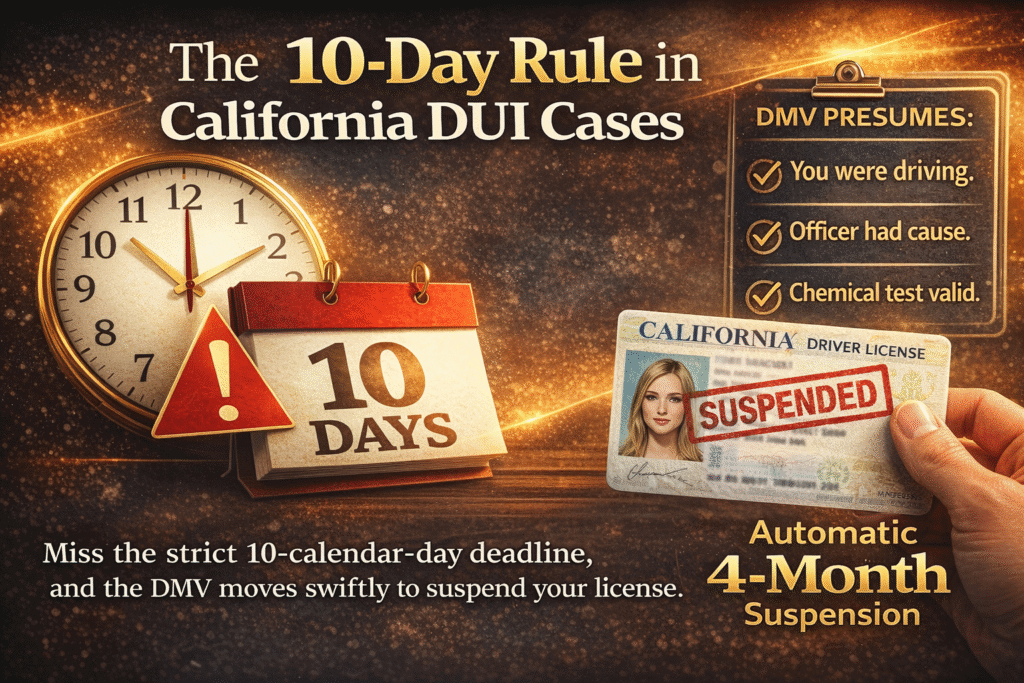
From the day of your arrest, the DMV presumes three things: that you were driving, that the officer had cause, and that the chemical test results are valid. Unless you request a hearing within 10 days, those assumptions become permanent findings. There is no burden on the DMV to prove its case unless you force the issue.
In DUI cases originating in Temecula, Riverside, Ontario, Rancho Cucamonga, or San Bernardino, this deadline is often missed by drivers who mistakenly believe their lawyer will “handle it later.” Later does not exist in DMV law. If you wait until day 11, you lose your right to a hearing. For a first-time offender, this results in an automatic four-month suspension (which can sometimes be converted to a restricted license after 30 days).
The Two-Front Battle: DMV vs. Criminal Court
Navigating a DUI requires a “dual-track” strategy because the objectives of each proceeding are different. Your DUI case will be prosecuted in criminal court, but your license is controlled by the DMV. These systems do not communicate in your favor. A judge at the Riverside Hall of Justice cannot stop a DMV suspension. A prosecutor at the San Bernardino Justice Center cannot override DMV authority.
The Administrative Track (DMV)
The DMV hearing is narrow in scope. The hearing officer only cares about three things: did the officer have reasonable suspicion to stop you, was the arrest lawful, and was your BAC actually .08% or higher?

The Criminal Track (Court)
The court case deals with punishment: jail time, fines, and your permanent criminal record. Penalties can include up to six months in jail for a first offense and fines ranging from $390 to over $1,000 plus assessments.
How to Request Your DMV Hearing
To preserve your rights, you or your attorney must contact the appropriate Driver Safety Office within 10 calendar days of receiving your suspension notice. You can make this request by telephone or in writing, though calling is generally faster and provides immediate confirmation.
When you contact the DMV, you’ll need to provide specific information including your full name, mailing address, date of birth, California driver’s license number, the arresting agency’s name, and the date of your arrest. It’s critically important to document your contact with the DMV, as there have been numerous cases where evidence of timely requests was lost or destroyed by the department.
The Importance of Documentation
Keep detailed records of every interaction with the DMV. Note the date and time of your call, the name of the representative you spoke with, and any confirmation numbers or case reference numbers provided. If possible, send a follow-up written request via certified mail to create a paper trail. Some drivers have successfully contested claims that they missed the deadline by producing phone records or written confirmation of their timely request.
Having an Attorney Handle the Request
Many DUI defense attorneys will handle the DMV hearing request as their first action when you retain them. This approach offers several advantages: attorneys know exactly which Driver Safety Office to contact based on where you were arrested, they understand what information the DMV needs, and they can immediately request a stay of suspension while scheduling the hearing.
An experienced attorney like Evan Vargas can also ensure that no procedural mistakes jeopardize your case from the very beginning. He’ll coordinate both your DMV defense and your criminal case strategy, often using the DMV hearing as valuable discovery for the court proceedings.
What to Expect at the DMV Hearing
DMV Administrative Per Se hearings are less formal than criminal court proceedings, but they follow specific procedures. The hearing takes place before a Driver Safety hearing officer, not a judge, and can be conducted in person at a local Driver Safety Office, via telephone, or through video conference using Microsoft Teams.
During the hearing, the DMV hearing officer serves multiple roles: they act as both the prosecutor presenting evidence against you and the decision-maker who will determine whether your license should be suspended. While this might seem inherently unfair, it’s how the administrative system operates in California.
Evidence and Burden of Proof
The DMV must prove its case using a “preponderance of the evidence” standard, which is significantly lower than the “beyond a reasonable doubt” standard used in criminal court. Essentially, the DMV only needs to show that it’s more likely than not that the conditions for suspension exist.
The hearing officer will introduce the department’s evidence, which typically includes the arresting officer’s sworn report, chemical test results, arrest reports, and any relevant documentation. While the arresting officer doesn’t usually testify at these hearings, you or your attorney have the right to subpoena the officer as a witness.
Your Rights During the Hearing
You have several important rights at a DMV hearing. You can review all evidence the DMV plans to use against you (called discovery), present your own evidence and witnesses, testify on your own behalf, cross-examine any witnesses the DMV presents, and be represented by an attorney.
Unlike criminal court, you’re not entitled to a court-appointed attorney if you can’t afford one. However, you can represent yourself or hire private counsel at your own expense. Given the technical nature of these proceedings and the stakes involved, legal representation significantly increases your chances of a favorable outcome.
Issues the Hearing Officer Will Consider
The hearing officer can only address specific statutory issues defined by California law. If you took a chemical test, the officer will determine whether the arresting officer had reasonable cause to believe you were driving under the influence, whether you were lawfully arrested, and whether you were driving with a blood alcohol content at or above the legal limit.
If you refused to take a chemical test, the issues shift slightly to include whether you were properly advised of the consequences of refusal and whether you in fact refused or failed to complete the test after being requested to do so by the officer.
Refusal Allegations Are Common and Often Mischaracterized
In Riverside and San Bernardino Counties, refusal allegations are aggressively pursued because they trigger longer suspensions and harsher consequences. However, refusal cases are rarely as clear-cut as police reports suggest.
Officers must properly advise drivers of the consequences of refusal, and the advisement must be understood. Confusion, language barriers, medical conditions, or unclear instructions can invalidate refusal claims. These issues are routinely overlooked unless challenged.
The DMV hearing is often the only forum where refusal allegations can be dismantled.
The Temporary License Is Not a Grace Period – It Is a Warning
After a DUI arrest, officers issue a pink Notice of Suspension that functions as a temporary license. This document gives drivers a false sense of security. It does not stop the suspension. It simply delays it.
For drivers arrested in Riverside, Murrieta, Rancho Cucamonga, or San Bernardino, this temporary license expires automatically unless a DMV hearing is requested. Once expired, driving without authorization becomes a new criminal offense.
Understanding this document and acting on it immediately is critical.
Local Knowledge Matters in Inland Empire DUI Defense
Riverside County and San Bernardino County DUI cases are not interchangeable. Enforcement practices vary by agency. Prosecutors rely heavily on DMV suspensions to pressure defendants into plea deals.
An attorney familiar with local arrest patterns, testing procedures, and courthouse dynamics can identify weaknesses early. This knowledge informs both the DMV defense and the criminal defense strategy.
Trial-ready DUI defense begins with immediate local action, not generic advice.
What Actually Happens When You Miss the 10-Day Deadline
If no hearing is requested, the DMV enforces the suspension automatically. Typically, this happens when your temporary license expires about 30 days after arrest. At that point, driving becomes illegal, and there is no appeal process available to reverse the decision.
In Riverside and San Bernardino Counties, this often leads to secondary legal problems. Drivers continue commuting out of necessity and are later charged with driving on a suspended license. That new charge complicates the DUI case, increases penalties, and damages negotiating leverage.
Once the deadline is missed, the defense is permanently weakened.
Penalties for 1st, 2nd, and 3rd DUI Offenses
The severity of a DUI conviction escalates rapidly with each prior offense within a ten-year “look-back” period.
- First Offense: Up to six months in jail, a six-month license suspension, and mandatory DUI school.
- Second Offense: Minimum of 96 hours to one year in jail, a two-year license suspension, and the mandatory installation of an Ignition Interlock Device (IID).
- Third Offense: A minimum of 120 days in jail and a three-year license suspension.
Felony DUI Your case can be upgraded to a felony if you have three or more prior convictions, or if the DUI resulted in an accident that caused injury or death.
Drug and Marijuana DUIs: Unique Challenges
California law treats “drugged driving” just as seriously as alcohol-related offenses under Vehicle Code Section 23152(f).
The Subjectivity of Marijuana DUIs
Unlike alcohol, there is no established “legal limit” for THC in the bloodstream that automatically proves impairment. Prosecutors must rely on the subjective opinions of Drug Recognition Experts (DRE).
Flawed Science
Because THC remains in the body long after the “high” has faded, a positive blood test does not necessarily mean you were impaired while driving. Challenging this science is a cornerstone of our defense strategy at Liberty Criminal Defense & Immigration.
The “Invisible Sentence”: Collateral Consequences
Beyond the court-ordered fines and jail time, a DUI conviction carries “hidden” punishments that can derail your future stability.
Employment and Licensing
A conviction can result in the suspension of professional licenses, such as those for nurses, security guards, or real estate agents. For commercial drivers, a DUI is a career-ending event because CDL holders face much stricter standards.
Education and Housing
Conviction of even a minor drug offense can render a student ineligible for federal student loans. Furthermore, some subsidized housing programs have strict “criminal activity” rules that could lead to the eviction of an entire family based on a single arrest.
Defensive Tactics: How We Fight Your Case
An experienced lawyer like Evan Vargas identifies weaknesses in the prosecution’s evidence that a self-represented individual would miss.

- Challenging the Stop: Was the initial traffic stop constitutional? If the officer lacked reasonable suspicion, all subsequent evidence may be suppressed.
- Disputing the Tests: We question the accuracy of breathalyzers and the subjective nature of Field Sobriety Tests (FSTs), which can be impacted by fatigue, medical conditions, or nerves.
- Investigating Misconduct: We look for procedural errors in the handling of blood samples or failures to follow Title 17 regulations.
Why Local Inland Empire Experience Matters
Laws are the same throughout California, but their application varies by courthouse. Evan Vargas routinely appears at the Riverside Hall of Justice, Rancho Cucamonga Superior Court, and the Southwest Justice Center.
Knowing the specific tendencies of local judges and prosecutors allows us to negotiate more effectively for reduced charges, such as “wet reckless,” or alternative sentencing options that avoid jail time. Our deep roots in Corona and the Inland Empire provide our clients with a significant tactical advantage.
Checklist: What to Do in the First 10 Days
If you have just been released after a DUI arrest, follow these steps immediately:
1. Locate your paperwork: Find the pink temporary license and the citation that lists your charges.
2. Do not talk to the police: Anything you say about the incident can and will be used against you.
3. Request your DMV hearing: You must do this within 10 days of the arrest date.
4. Consult with Evan Vargas: We can handle the DMV request for you and begin building your criminal defense before your first court appearance.
Take Control of Your Future Today
If you were arrested for DUI in Riverside County or San Bernardino County, and your case is headed to Murrieta, Riverside, Rancho Cucamonga, or San Bernardino, the clock is already running. Your freedom and your right to drive are too important to leave to chance. A DUI does not have to result in a conviction or a lost career, but the first 10 days are the most critical moment of your case.
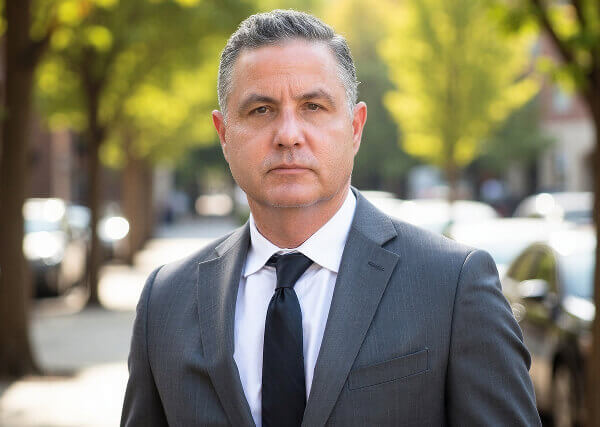
Contact Evan Vargas at Liberty Criminal Defense & DUI for a free, confidential consultation. We serve clients throughout Corona, Riverside, and San Bernardino counties with relentless advocacy and proven results.
Call us now at 909-773-2356 or visit our Corona office at 4160 Temescal Canyon Rd, Suite 401.
Frequently Asked Questions (FAQ)
Can I get a restricted license if my license is suspended?
In many first-time DUI cases, you may be eligible for a restricted license that allows you to drive to and from work and DUI school, typically after an initial 30-day “hard” suspension or by installing an IID.
What happens if I refuse the breath or blood test?
Refusal triggers a mandatory one-year license suspension with no possibility of a restricted license, and it can be used against you as an “aggravating factor” in court.
Will a DUI show up on a background check?
Yes. A DUI is a criminal conviction that will appear on background checks for employment, housing, and professional licensing unless it is later expunged.
Can I be charged with a DUI for prescription drugs?
Yes. If a legal medication impairs your ability to drive safely, you can be charged under Vehicle Code 23152(f).
Is it too late if 10 days have already passed?
The DMV is very strict, but you should still contact an attorney immediately to see if any legal exceptions apply or to focus on your upcoming court case.
Disclaimer: This blog post is intended for informational purposes only and does not constitute legal advice. Every case is unique, and outcomes depend on specific facts and circumstances. For legal advice regarding your particular situation, please consult with a qualified criminal defense lawyer.